


Set entity-level canonical URLs and robots rules to fix duplicate content in PrestaShop


Product Canonical Manager is a module for PrestaShop stores that gives every storefront page one definitive address for search engines and keeps duplicate versions from competing with it. Installation opens a guided setup, and the first storewide policy is ready in minutes.
The problem begins when one product or category appears under addresses created by filters, campaign parameters, pagination, language paths or another store domain. The module finds those competing addresses, groups them in a report and points their ranking signals toward the commercial page that should appear in search results.
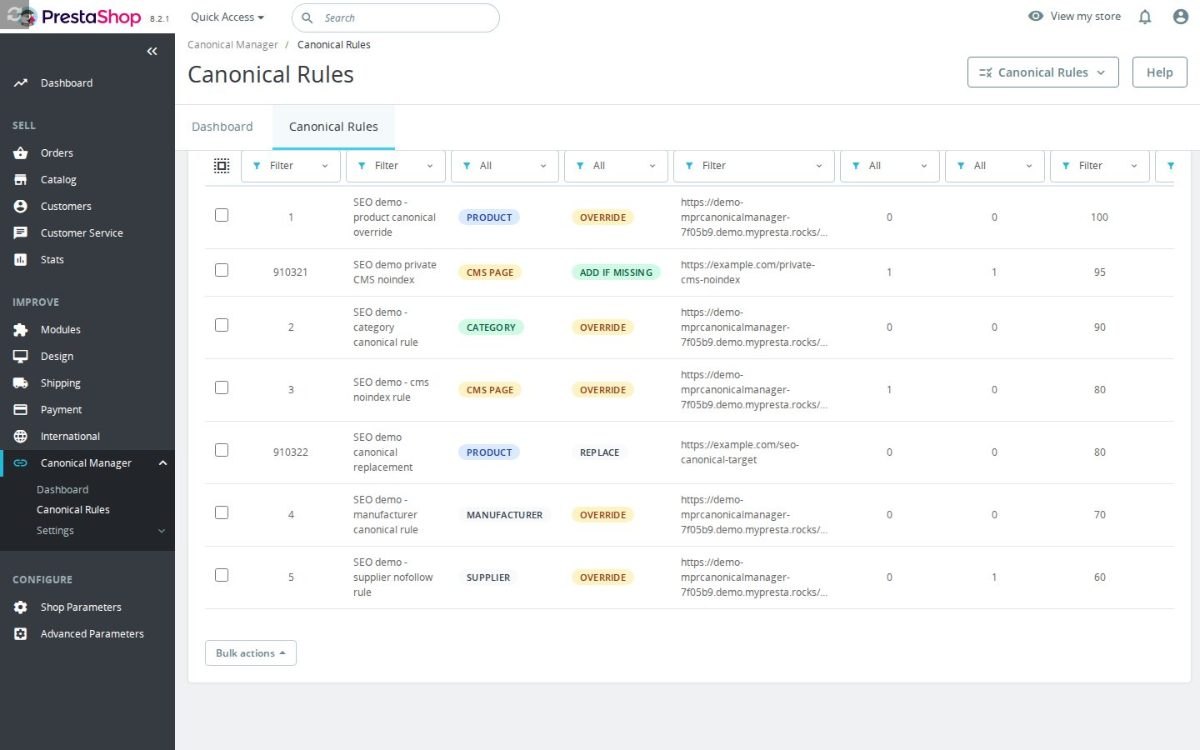
The module manages products, categories, CMS pages, manufacturers, suppliers and custom store routes through individual or bulk rules. Each rule replaces an existing canonical address, fills one in only when it is missing or uses a destination of your choice. Priority settles overlapping rules, while noindex and nofollow keep low value pages out of results.
Custom destinations are stored separately for every language, complete hreflang sets include x-default, and policies apply globally or to one store in a multistore setup. Parameter and pagination cleanup, path conventions, rule preview, import, export and the coverage dashboard provide detailed control after the quick start.
The result is one page collecting the signals it earned, the right language appearing in each market, fewer indexing mistakes after catalogue changes, and an SEO policy the team sees and manages from one place.
What does Product Canonical Manager settle?
- One definitive canonical address for every page that belongs in search results
- Precise individual and bulk rules across the entire storefront
- Duplicate address detection, cleanup and verification
- Correct language, regional domain and multistore relationships
- Control over conflicts, indexing instructions and rule portability
- A dashboard that shows coverage and the address generated for each page
Product Canonical Manager turns canonical addresses, hreflang relationships and search engine indexing instructions into one store policy. A guided setup handles the common case in minutes, while the visual rule editor covers complex catalogues with previews, priorities and store scope.

Which pages does one rule cover?
A rule targets one page, a selected group or every matching page. Products, categories, CMS pages, CMS categories, manufacturers, suppliers, the home page, search results, module pages and custom routes all use the same editor. Product selections include categories, brands, suppliers, tags, attributes and features, with inclusions and exclusions shown before the rule is saved.
Broad and narrow rules work together because every rule has a priority. The first matching address rule decides the canonical destination, while compatible indexing instructions from other matching rules remain in force. A German product family, one supplier range and a single exception therefore stay understandable inside the same policy.

How are competing addresses reduced to one?
The built in scan finds pages whose content is reachable through several addresses and groups the alternatives under the chosen destination. Its report identifies tracking values, referral values, session values, sorting, filters, pagination, secure and non secure forms, and duplicate canonical declarations. Each row shows the affected page and the rule that resolves it.
On the storefront, the module leaves one deterministic canonical address even when the theme supplied none, one or several. It removes only the parameters listed in the settings, handles pagination separately, and applies the chosen lowercase and trailing slash conventions without changing the catalogue record. Ranking signals therefore gather around the address selected for sale and search.
How does every market keep the right page?
Custom canonical destinations are stored per language. The module builds a complete hreflang relationship for active languages, adds one x-default destination and validates the self reference and return links. Regional domains and language specific addresses remain separate, so a local product page is not folded into the wrong master version.
In a multistore installation, a policy is global or belongs to a selected store. Shared rules provide the common foundation, store rules handle local catalogues and domains, and explicit precedence resolves overlaps. The dashboard reports each store separately as well as the inherited policy.

How much control stays with the merchant?
Each rule uses one of three clear conflict policies: replace the existing canonical address, add the clean address only when none exists, or use a custom destination. The same rule marks matching pages noindex, nofollow or both while preserving other compatible search engine instructions already present on the page.
Rules are paused, their priorities are changed and they are deleted from the list. Import and export move multilingual destinations, selections, priorities, states and store scope between shops, with a dry run that identifies conflicts before anything changes. When a product, category, CMS page, manufacturer or supplier disappears, its direct rules disappear with it.

How is the result verified after setup?
The dashboard reports active rules, exact page coverage by type and store, pages excluded from results, language relationship status, cleanup settings and recent changes. A generated address journal records which rule handled each page and which canonical and hreflang entries were written, so a theme change, catalogue import or campaign has a visible before and after result.
Installation diagnostics confirm that the rule data and storefront processing are intact. All changes are applied as the page is prepared, with nothing extra loading for shoppers and no customer, order or browsing profile stored. The quick start remains small, while the evidence and configuration stay detailed enough for a large international catalogue.

-
Referencemprproductcanonicalmanager
-
In stock2147483647 Items
-
PrestaShop CompatibilityPS 1.7 – 9.x
-
Pricing ModelOne-time Purchase
-
Module TypeFront & Back-office
-
GDPR RelevantNo
-
Business GoalIncrease Traffic
-
External Account NeededNo
-
Module ComplexityFeature-Rich Module
-
Customer Journey StageAttract Visitors
-
Works With PlatformNo External Platform
What customers say about us
Company reviews
5.0
★
★
★
★
★
(4 reviews)
Loading customer reviews...
No product reviews yet
Be the first to share your experience with this module.
Write a Review
Product Canonical Manager helps your store tell search engines which URL is the main version of each product, category, CMS, manufacturer, or supplier page. It is built for duplicate-content cases caused by multiple category paths, campaign parameters, and pages that need their own canonical, hreflang, noindex, or nofollow tags.
Have a question about this product?
Our experts are here to help. Ask anything about installation, compatibility, or specifications.
1301
questions
9
categories
2013
building modules since
1.6–9
PrestaShop versions
v1.1.82026-05-27
- Addedcomplete FR/DE/ES/IT/PL translations
Loading full changelog...
Works Well With Product Canonical Manager
Modules our team genuinely pairs with this one, and exactly why each belongs in the same setup.
Complement
Product Canonical Manager is helping your store decide which product, category, CMS, manufacturer or supplier pages should carry the strongest search signal, cutting duplicate-content confusion. That decision matters most when search engines are actually crawling the pages, and a clean canonical strategy still needs the right URLs to be discoverable.
Advanced SEO Sitemap Builder covers discovery, generating XML sitemaps across products, categories, CMS, brands, suppliers and core pages. The two are complementary: one tells crawlers which URLs exist and deserve attention, the other clarifies which of several similar URLs should be treated as primary, each managed separately.
Running both, your discovery and consolidation strategies line up. The pages you submit for crawling are also the ones you have marked canonical, so crawl attention is less likely to scatter across variant URLs, and search engines get a consistent story about which pages to find and which to treat as authoritative.

Complement
Product Canonical Manager keeps your store's duplicate-content signals tidy by choosing which pages carry search weight, but consolidating signals is only half the internal-SEO picture. How authority flows between your important pages depends on the links connecting them, which canonical rules do not create.
Automatic Internal SEO Linker covers that, turning chosen keywords into controlled internal links across existing content so shoppers and search engines get clearer paths to key products, categories and pages. It works alongside canonical management: one decides which page is authoritative, the other builds the link paths leading toward your pages.
Together they strengthen internal SEO from two directions. Canonical rules concentrate signals on the pages you want ranked, while controlled internal links help route relevance toward those same pages. You manage each from its own back office, but the combined effect is a cleaner, more deliberate internal structure rather than relying on theme edits and scattered manual links.

Complement
A store running Product Canonical Manager has taken control of which URLs carry search weight, but the URLs themselves may still be the cluttered, technical addresses PrestaShop generates by default. Clean canonical decisions sit on top of addresses that are hard to read and share.
Smart SEO Friendly URL Manager handles that address layer, letting you define cleaner URL patterns for products, categories, CMS pages, manufacturers and suppliers from the back office. It complements canonical management without overlapping: one shapes how addresses look, the other decides which address is authoritative, each in its own workflow.
Used together, your canonical, primary URLs are also clean and shareable, and old traffic is less likely to be lost when addresses change. Shoppers see professional links while search engines get a consistent canonical signal pointing at those tidy URLs, so the readability work and the duplicate-content work reinforce rather than complicate each other.

Complement
Product Canonical Manager lets your store set canonical, noindex, nofollow and even hreflang rules per entity, which already touches multilingual signalling. On a larger multilingual catalogue, though, maintaining a complete and consistent set of alternate-language tags across every product, category and CMS page is a substantial job in its own right.
Hreflang Tags Manager focuses entirely on that, adding alternate-language link tags in the page header using PrestaShop's own URL generation across products, categories, CMS pages, manufacturers and suppliers, reading your active shop languages. It complements canonical management by specialising in the language-correspondence layer.
Together you get duplicate-content control and thorough hreflang coverage handled by tools built for each. Canonical rules keep signals concentrated on the right pages while the hreflang manager helps search engines route each searcher to the correct translated version, which is useful when the volume of language variants makes hand-maintained tags impractical.
 30 days return right
Easy return - no questions asked
 Plug & Play Modules
Install, set up and take profit
 Dedicated Support First
Priority Help & Satisfaction Over Sales
You might also like


