

Show recent views and sales signals on your PrestaShop product pages


Product Sales & Views Live Stats is a module for PrestaShop stores that turns real product activity into visible proof of demand: unique views, confirmed sales and people looking now. Installation and first launch fit on one settings screen, and useful defaults put the first display in place immediately.
Interest normally stays hidden in visitor and order records, even when it would help a buyer choose between similar products. The module brings that evidence onto product pages and product lists, while minimum thresholds keep quiet figures out of sight until they support the decision.
You decide which signals appear, what period they cover and whether sales mean units sold, orders or unique buyers. Separate controls set the active-viewer window, the recent-purchase limit, observed or adjusted display values, and the privacy level for names, location and purchase time.
Independent displays cover product pages, product lists, home-page products and quick view. Position, products, categories, brands, customer groups and devices determine where each one appears. Every shop language has its own labels and supporting text, each store keeps its own settings, and the appearance follows the active theme on large and small screens.
The result is clearer proof of product demand, less hesitation around unfamiliar items, stronger products standing out earlier, and a setup that starts simply while retaining deep control.
What changes in the store after installation?
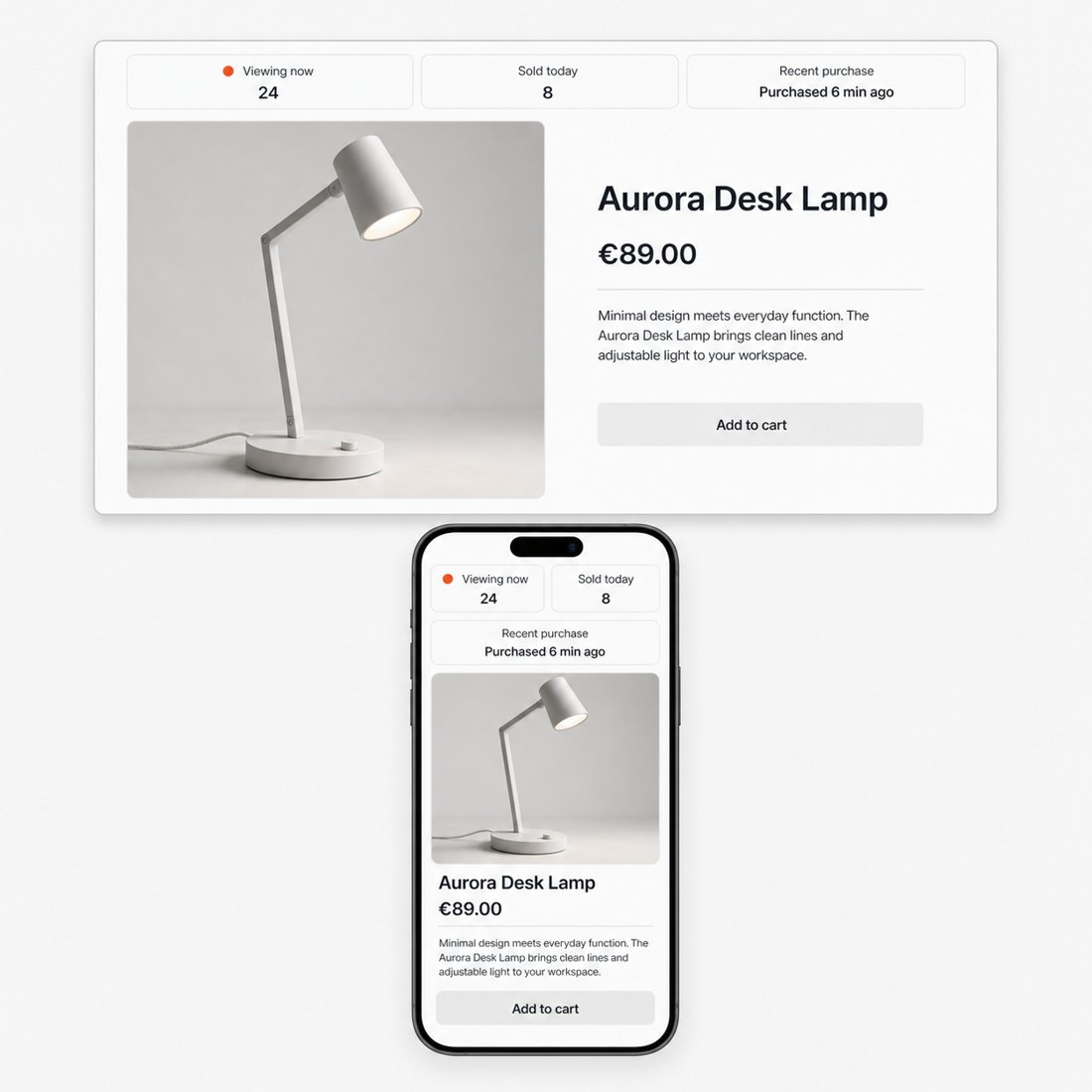
Product Sales & Views Live Stats adds a compact demand display to a PrestaShop store. It shows unique product views, sales from confirmed orders and people actively looking now, then carries the sales signal into product lists where it influences comparison before a product page opens.
- Three signals in one place: views, sales and current interest answer different buyer doubts.
- Numbers with a defined meaning: clean visitor counts and a chosen sales measure keep the message understandable.
- Evidence behind the total: recent confirmed purchases give the sales figure substance.
- The right place and audience: surfaces, position and targeting rules decide where proof helps.
- Control for every store: thresholds, periods, wording and privacy follow each language and shop.
- A display that stays current: active presence, return updates and theme matching keep it useful.
The initial settings are ready for a short launch. The same screen also provides the depth needed for different catalogue segments, customer groups, devices, languages and stores.

What does each of the three numbers mean?
Views count distinct visitors within the selected period. Repeated openings by the same guest are combined, while known automated and internal traffic stays outside the total, so one person refreshing a page does not create a crowd.
Sales come from orders that the store has confirmed as valid. The merchant chooses whether the storefront reports units sold, orders or unique buyers. The current-interest figure represents people actively viewing that product, removes those who leave and refreshes while the page remains open.

What stands behind the sales figure?
The sales total is not an isolated claim. Selecting it opens recent confirmed purchases for that product, with the buyer name, location, purchase time and quantity shown according to the shop's privacy setting. This turns popularity into evidence that has a source in real orders.
Privacy levels mask or hide names, generalise location and broaden purchase time where a precise detail would reveal too much. The merchant therefore keeps the reassuring context and decides how much personal information reaches a public page.

Where do the signals appear and who sees them?
Separate display instances serve product pages, category and search lists, products on the home page and quick view. Each instance has its own position, signals, threshold and wording, so a compact sales badge in a list and a fuller three-part bar on a product page perform different jobs.
Inclusion and exclusion rules cover individual products, categories, brands, customer groups and device types. Weak figures remain invisible below the selected threshold, while proven items gain a demand signal during the choice between alternatives.
How much control stays on one settings screen?
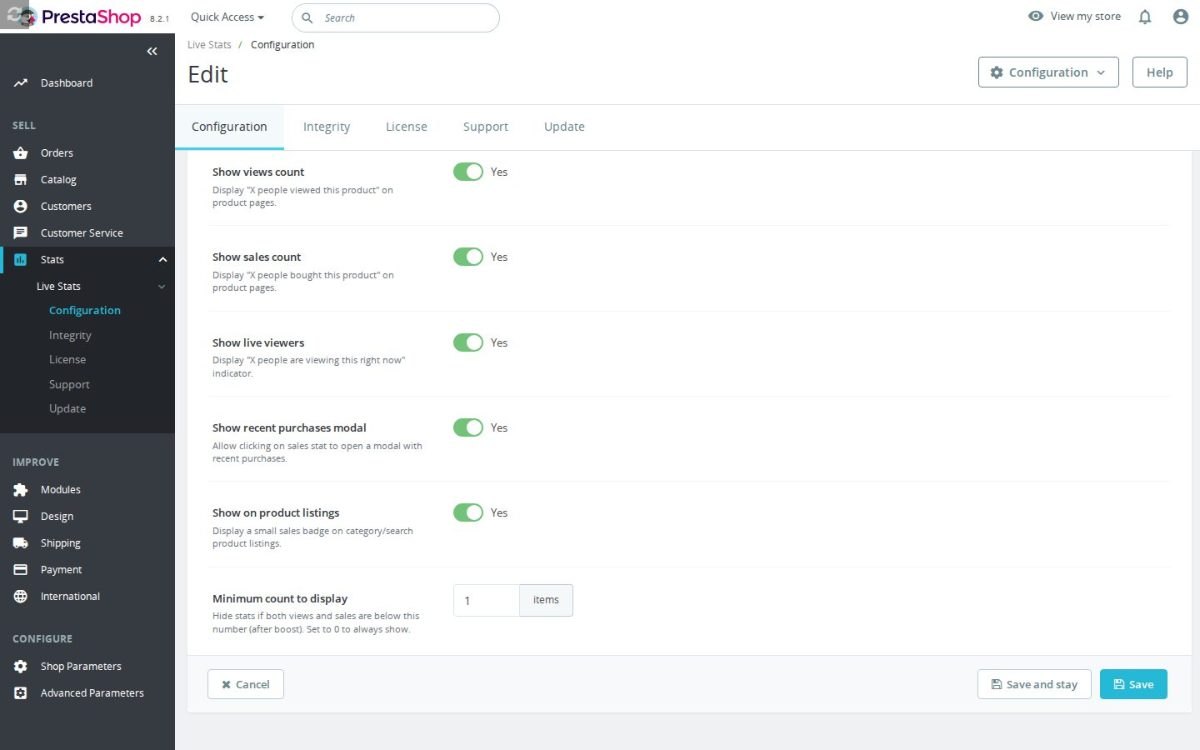
The screen contains switches for every signal and surface, the counting period, current-interest window, sales measure, recent-purchase limit and minimum display threshold. Views and sales use either observed totals or separately adjusted display values, with a preview showing the exact storefront result.
Labels, supporting text and panel wording are edited for every shop language. In a multistore setup, each store has its own periods, thresholds, targeting and privacy choices, with shared values inherited where one policy serves several stores. Ready defaults keep the first launch short without limiting later configuration.

How does the display stay current and fit the storefront?
The appearance follows the active shop theme, including colours, borders, corners, shadows and motion. The bar rearranges for small screens, and the recent-purchases panel fits mobile widths without turning the product area into a separate design project.
Current-interest presence refreshes while the page is open. When a buyer returns to the product tab after an absence, the module requests fresh counts and recent purchases again. Old view records leave storage automatically according to the chosen period, while the demand data remains in the shop's own visitor and order records.
-
Referencemprproductsalesviewslivestats
-
In stock2147483647 Items
-
PrestaShop CompatibilityPS 1.7 – 9.x
-
Pricing ModelOne-time Purchase
-
Module TypeFront & Back-office
-
GDPR RelevantNo
-
Business GoalStreamline Operations
-
External Account NeededNo
-
Module ComplexityFeature-Rich Module
-
Customer Journey StageManage Store
-
Works With PlatformNo External Platform
What customers say about us
Company reviews
5.0
★
★
★
★
★
(4 reviews)
Loading customer reviews...
No product reviews yet
Be the first to share your experience with this module.
Write a Review
Product Sales & Views Live Stats adds product-page popularity badges for views, confirmed sales, and current live viewers. It helps shoppers see real buying and browsing activity before they decide.
Have a question about this product?
Our experts are here to help. Ask anything about installation, compatibility, or specifications.
1301
questions
9
categories
2013
building modules since
1.6–9
PrestaShop versions
v1.0.112026-05-27
- Addedcomplete FR/DE/ES/IT/PL translations
- FixedAdd noindex header to stats ajax endpoint
- FixedAdd theme detector support
Loading full changelog...
Works Well With Product Sales & Views Live Stats
Modules our team genuinely pairs with this one, and exactly why each belongs in the same setup.
Complement
Product Sales & Views Live Stats turns recent product activity into configurable social proof on product pages, counting distinct guest views in a window and showing sales from valid orders, with optional listing badges and a recent purchases modal. That works on the product page itself, where a shopper is already focused on one item.
Sales Popup is a separate tool that shows controlled activity messages while shoppers browse anywhere in the store, using real valid orders, generated notifications or a mixed mode, with filters for order age and state. It reaches shoppers across the journey, not only on the product page.
Run together, you get social proof at two scales: the on-page counters that reassure someone studying a specific product, and the store-wide popups that keep a quiet store feeling active as people browse. Both draw on real order activity, so the signals stay credible.

Complement
Product Sales & Views Live Stats shows shoppers that products are being viewed and bought, turning recent activity into configurable on-page social proof. That answers is this product popular, but it does not address the separate worry around payment, returns or delivery.
Trust Badges displays configurable reassurance messages on product pages and in the cart, where doubts about payment, returns, delivery or support can stop an order, with each badge editable from Back Office. It displays your stated confidence messages rather than guaranteeing anything.
Used alongside each other, the two tools answer two different shopper questions at the same spot: popularity from the live stats and reassurance from the badges. Together they reduce more of the hesitation that stalls a purchase than either could on its own.

Bundle
Product Sales & Views Live Stats turns recent product activity into configurable social proof, counting distinct guest views within a window and showing sales from valid orders, with optional listing badges and a recent purchases modal. Its strength is live, recent proof: what is being viewed and bought right now.
Total Products Sold Counter adds a different signal, a compact all-time units-sold badge built from order_detail quantities on valid orders for a product. Rather than recent activity, it shows the cumulative total a product has sold over its whole history, a durable proof point that does not depend on current traffic.
The two reinforce each other because they prove different things. Live Stats shows momentum through recent views and purchases, while the counter shows depth through lifetime units sold, so a product page can carry both a fresh, active feel and evidence of a long track record, giving hesitant shoppers two distinct reasons for confidence.

Complement
Product Sales & Views Live Stats shows that a product is being viewed and bought, giving shoppers activity-based social proof drawn from real orders. That signals interest, but it does not tell a buyer how customers rated the product once they had it.
Reviews & Ratings fills that gap as a separate native tool, adding moderated ratings, written feedback, optional photo reviews and review criteria inside PrestaShop, so shoppers see the customer verdict rather than only the activity count.
Used alongside each other, the two cover both halves of social proof on the product page: how much a product is bought, and how reviewers rate it. Together they give shoppers a fuller, more believable picture than activity counts alone, supporting the decision at the point it is being made.
 30 days return right
Easy return - no questions asked
 Plug & Play Modules
Install, set up and take profit
 Dedicated Support First
Priority Help & Satisfaction Over Sales
You might also like


