


Add a second SEO-friendly category description to your PrestaShop store with one extra field


Second Category Description is a module for PrestaShop stores that adds a separate formatted content area to category pages and places it after the products. Installation activates the standard position immediately, and the first additional description is written in the category editor the team already uses.
A category page needs enough substance to explain the range, answer buying questions and connect related parts of the catalogue, yet a long introduction above the products turns useful content into an obstacle. The second area separates these jobs: a concise opening remains at the top, the product list stays prominent and the detailed guidance receives its own space below.
The module stores a distinct description for every language, shop and category. It normally appears only on the first page of the listing, and the merchant chooses a regular-width block, a full-width section or a precise position in the active theme. Long text, headings, images, tables and internal links remain available, while a compact preview with an accessible expansion control keeps extensive content comfortable on smaller screens.
Theme scanning identifies suitable category positions, creates the selected placement and monitors it after theme changes. A safe standard position takes over if the chosen place disappears, while the dashboard shows covered and uncovered categories, recent edits and language gaps. Every placement is reversible, and content moves to the native category field through a previewed migration when the store needs it.
The result is products visible sooner, more room for useful category content, consistent publishing across languages and shops, and a setup that starts simply while retaining detailed control over placement and presentation.
What does Second Category Description change on a category page?
Second Category Description gives every category a second formatted content area that sits apart from the short introduction. The product list remains the main shopping surface, while explanations, buying guidance, comparison points and internal links receive the space they need below it.
The six questions below map the complete module:
- Page structure: how products remain prominent while the category gains substantial content.
- Editing: how every language, shop and category keeps the right version.
- Placement: how the active theme receives the block in the intended position.
- Presentation: how long content stays readable on large and small screens.
- Theme changes: how monitoring, fallback and reversible changes protect the result.
- Setup and ownership: how the module starts quickly and how content remains portable.

How do products stay first without leaving the category thin?
The native category introduction remains available for a short explanation near the title. The second description begins after the product listing, so names, photographs, prices, filters and buying controls appear before the longer material. The merchant gains room for size guidance, range differences, answers to recurring questions and links to related categories without turning the first view into an article.
By default, the additional block appears only on the first page of a paginated category. Later pages remain focused on their next set of products instead of repeating the same long passage. When the text is extensive, a compact preview presents the opening portion and an accessible control expands the complete content. Separate desktop and mobile limits keep the same information available without filling a smaller screen at once.

How does the team manage every category, language and shop?
The additional editor appears directly after the normal description in the category form. It accepts formatted text, headings, lists, images, tables and links, and it saves a separate value for each active store language. Older category forms receive the same multilingual editing flow, so the content programme does not split into two administration methods.
Each shop keeps its own category text. The dashboard counts categories with and without an additional description for the current shop, identifies missing language versions and lists recent changes with a direct route back to the relevant category. A large catalogue therefore becomes a measurable publishing plan rather than a collection of fields that nobody knows is complete.

How does the content reach the right place in the active theme?
The standard mode places the block in the normal area after the category listing and needs no placement work. Full-width mode creates a broader section while keeping its inner content aligned with the shop. For a theme with a different structure, the placement manager examines the active theme, follows its connected templates and ranks suitable category positions.
Accepting the selected position activates it immediately and confirms that the block appears on a real category page. Child themes receive their own minimal placement, so the parent theme remains untouched. Every saved placement has its own active state and width choice, while unsuitable positions from product, content or other page types stay outside the category workflow.

What protects the description when the theme changes?
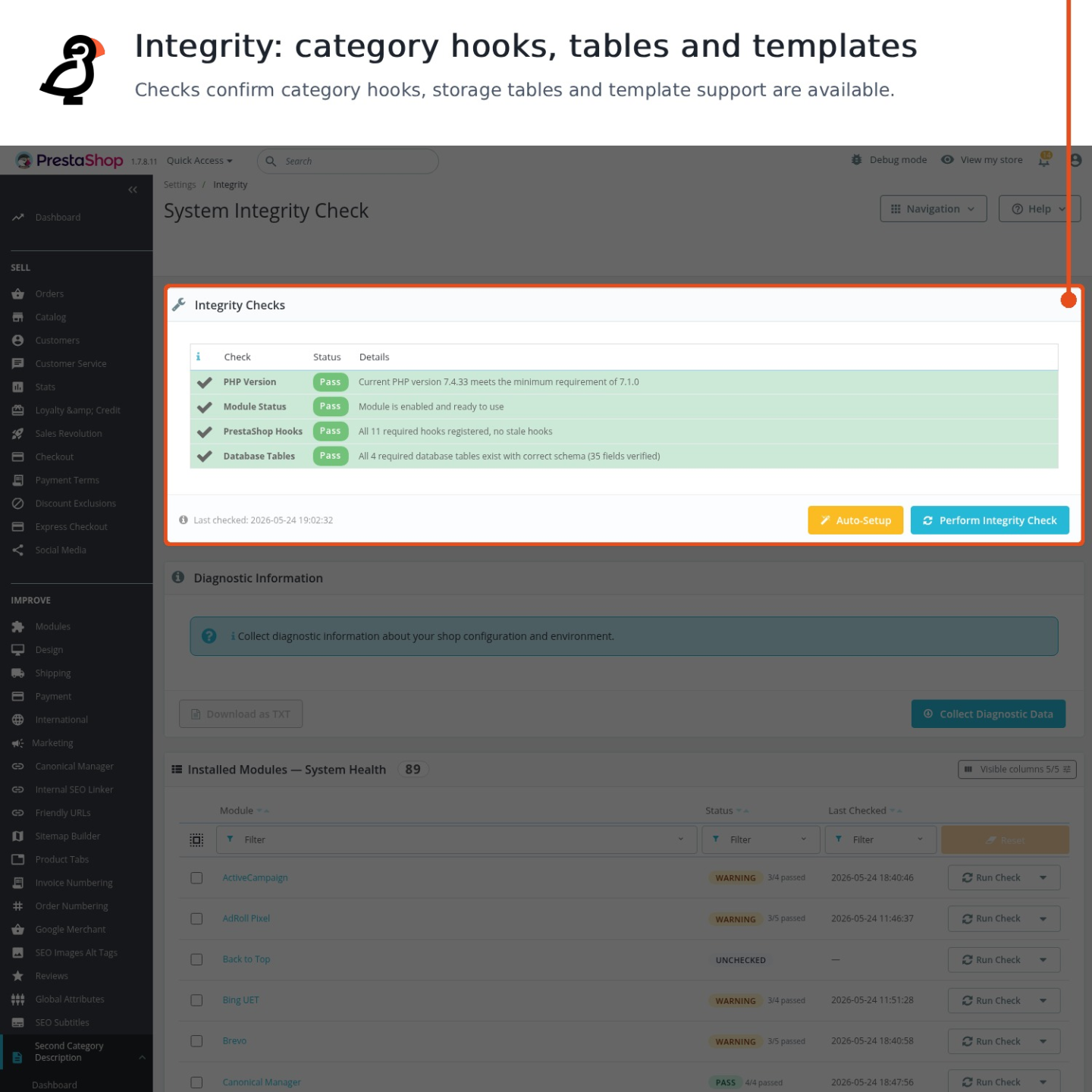
The module records the file and exact marked addition used for the selected placement. A later theme change is compared with the accepted state. If the position changes or disappears, the dashboard raises a persistent warning and the standard below-product position takes over immediately, so published category content does not silently vanish.
Removing one placement reverses only the marked module addition. Removing all placements reports the result for every affected file, keeps a recovery record for anything that could not be restored and never erases the route to a failed cleanup. The same safeguards apply when the module is removed from the store.

How small is the start, and how far does configuration go?
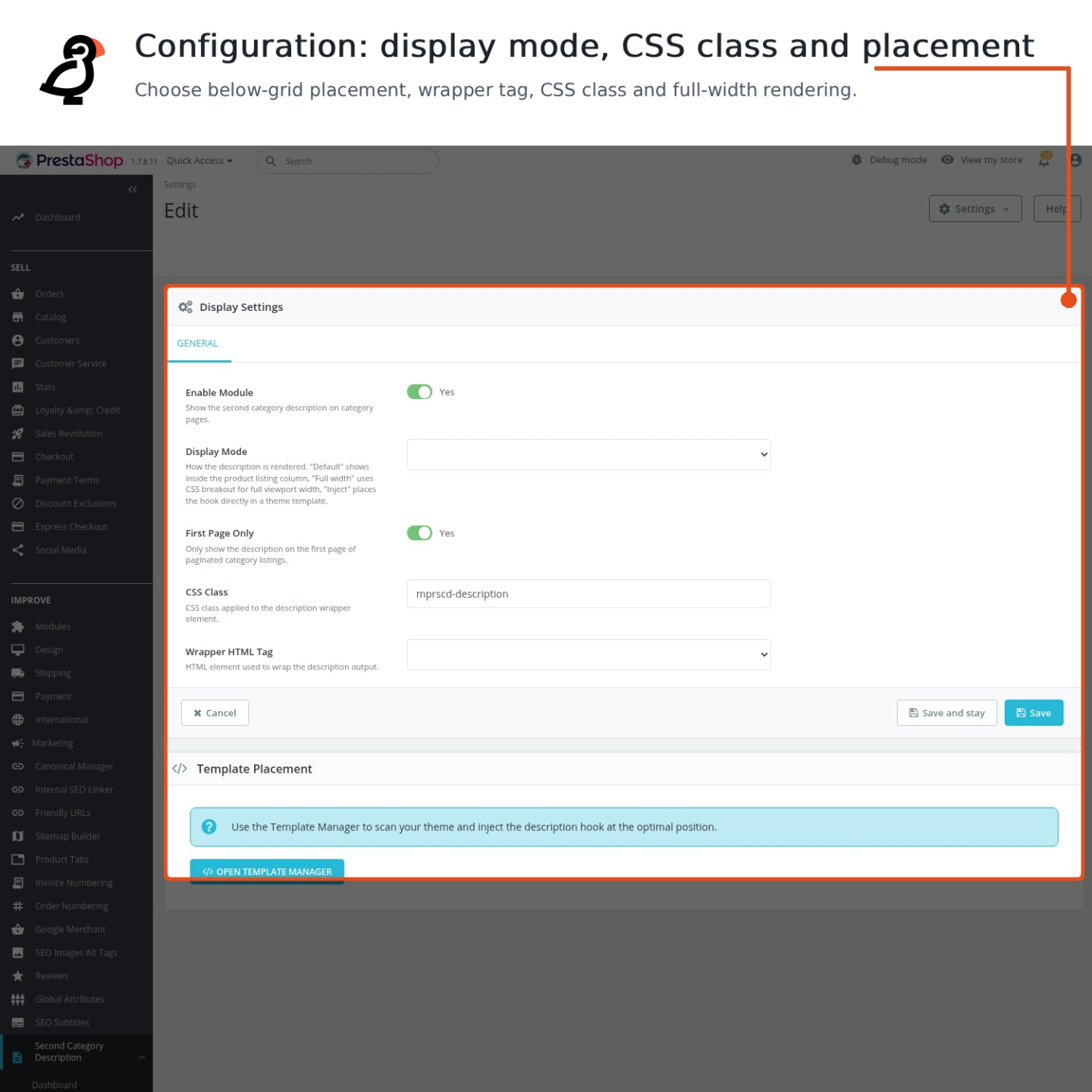
Installation enables the standard position and first-page-only behavior. The first useful result requires only a saved second description in the existing category form. The settings then open deeper control over module status, normal or full-width presentation, the outer content element, the design class, pagination and the compact view on desktop and mobile.
The shop retains ownership of every text. Where the platform has its own additional category field, migration begins with a preview, shows existing destination content and lets the merchant keep it or replace it category by category. The result reports copied, skipped and failed language values before the module storage is retired, so moving the content never becomes a blind overwrite.

-
Referencemprsecondcategorydescription
-
In stock2147483647 Items
-
PrestaShop CompatibilityPS 1.6 – 9.x
-
Pricing ModelOne-time Purchase
-
Module TypeFront & Back-office
-
GDPR RelevantNo
-
Business GoalIncrease Traffic
-
External Account NeededNo
-
Module ComplexityFeature-Rich Module
-
Customer Journey StageAttract Visitors
-
Works With PlatformNo External Platform
What customers say about us
Company reviews
5.0
★
★
★
★
★
(4 reviews)
Loading customer reviews...
No product reviews yet
Be the first to share your experience with this module.
Write a Review
Adds a second rich-text description field to category pages and displays it below the product grid, so you can publish longer SEO copy, buying guides, internal links, and category advice without pushing products down the page.
Have a question about this product?
Our experts are here to help. Ask anything about installation, compatibility, or specifications.
1301
questions
9
categories
2013
building modules since
1.6–9
PrestaShop versions
v1.1.72026-05-27
- AddedAdd template injection manager assets
- Addedcomplete FR/DE/ES/IT/PL translations
- FixedRegister second description injection tables
Loading full changelog...
Works Well With Second Category Description
Modules our team genuinely pairs with this one, and exactly why each belongs in the same setup.
Complement
Second Category Description gives your category pages room for richer SEO copy below the product grid, adding depth without pushing products down. That depth lives at the bottom of the page, which means the top of the category and the headings themselves still rely on plain names for clarity.
PrestaShop Product SEO Subtitles complements that by adding a managed second line under category and product headings, plus CMS, manufacturer and supplier headings. The two place content in different zones: the subtitle clarifies near the top, the second description adds substance at the bottom, leaving the shopping grid uncluttered between them.
Running both, a category communicates well from top to bottom. Shoppers get an immediate, benefit-led subtitle and, if they read on, deeper context below the products, while you keep main titles clean. It is a tidy division of the page where each tool improves a different region rather than crowding the same space.

Complement
Second Category Description lets you place substantial SEO copy below the product grid on category pages, building content depth where it does not disrupt shopping. That copy is valuable, but on its own it sits in isolation unless something connects it to the other important pages on your store.
Automatic Internal SEO Linker covers that connective layer, turning chosen keywords into controlled internal links across existing content, including the kind of descriptive text your category descriptions add. It complements the depth tool: one creates richer content, the other helps relevant keywords within content link toward key products, categories and pages.
Together your category pages gain both substance and structure. The second description provides the words and context while internal linking helps those words build clearer paths for shoppers and search engines, so the depth you add is not stranded at the foot of the page but woven into the site's internal navigation and topical relationships.

Complement
Second Category Description adds depth to your category pages, giving each one richer multilingual copy below the grid. That improves the category tree itself, but it does not create the standalone editorial content, buying guides and advice, that pulls in earlier-stage search traffic outside the catalogue structure.
Blog Revolution provides that surface, keeping native articles, categories, tags, authors and clean blog pages inside the shop so content can attract search traffic and lead readers toward products. It complements the category work by covering content the category tree was never meant to hold, while you keep enriching categories separately.
Used together, your store grows depth in two distinct places: substantial copy on the categories shoppers browse, and topical articles that attract people researching before they shop. Each tool owns its own content type, but the combined catalogue plus blog gives search engines more relevant pages and gives readers more routes toward your products.

Complement
Second Category Description gives a category page extra SEO copy below the grid, but the visible heading at the top is still the category name as used in menus, breadcrumbs and URLs. So the page can gain depth at the bottom while its most prominent line stays generic.
Custom Category H1 fixes that top-of-page weakness, storing per-category, per-shop H1 overrides with multilingual values so the heading reads more specifically without renaming the category elsewhere. It complements the second description by improving the primary heading where the description improves the supporting body copy.
Together a category opens with a stronger, more specific H1 and closes with deeper SEO content, while navigation and URLs stay tidy. Shoppers understand the page faster from the heading and search engines see both a focused title and substantive copy, with the two tools handling the top and bottom of the same page rather than overlapping.
 30 days return right
Easy return - no questions asked
 Plug & Play Modules
Install, set up and take profit
 Dedicated Support First
Priority Help & Satisfaction Over Sales
You might also like


