


Add JSON-LD structured data to PrestaShop for richer Google search results


Automatic SEO Schema Rich Snippets is a module for PrestaShop stores that turns product, variant, delivery, return and business details into structured information on every relevant shop page. Installation takes minutes: the main page types start with useful defaults, while one panel holds the deeper settings.
A growing catalogue changes every day, but search engines and shopping assistants still need one consistent account of each product and the merchant behind it. The module keeps current price, stock, identifiers, reviews, delivery terms and return conditions together, so eligibility is assessed from the same facts that govern the order.
Each product and combination keeps its own attributes, images, reference, barcode, price and availability. Approved reviews feed the rating, and visible multilingual FAQs stay synchronized with the answers prepared for search systems. Categories, editorial pages, practical guides, events, business identity and on-site search receive descriptions suited to their purpose.
The merchant controls every information family, shop, language and individual exception. A catalogue audit finds missing facts, desktop and mobile previews show the prepared result, public-page tests return their findings, and selective cleanup replaces duplicate information without removing unrelated data.
The result is a simple launch, detailed control as the catalogue grows, fewer search-data errors, clearer product and policy information, and one maintainable source for the whole store.
What information does the module keep aligned across the shop?
Automatic SEO Schema Rich Snippets is a PrestaShop module that keeps the complete commercial context of a shop in one coordinated description. Products, combinations, delivery, returns, reviews, FAQs, categories, editorial pages, shop identity and on-site search form one consistent set of structured information.
Installation activates useful coverage with sensible defaults. The same panel then gives precise control over page types, catalogue sources, business details, policies, shops, languages and individual exceptions as the store grows.
- Products and combinations. Every variant carries the details that distinguish it.
- Delivery and returns. Timing, cost, destination and return conditions stay with the offer.
- Whole-shop coverage. The homepage, navigation, categories, CMS pages and search receive the right description.
- Reviews and FAQs. Customer evidence and approved answers remain visible and synchronized.
- Audit and cleanup. Missing facts and duplicate sources surface before search engines meet them.
- A clear boundary. The module controls data quality, while search engines control presentation.
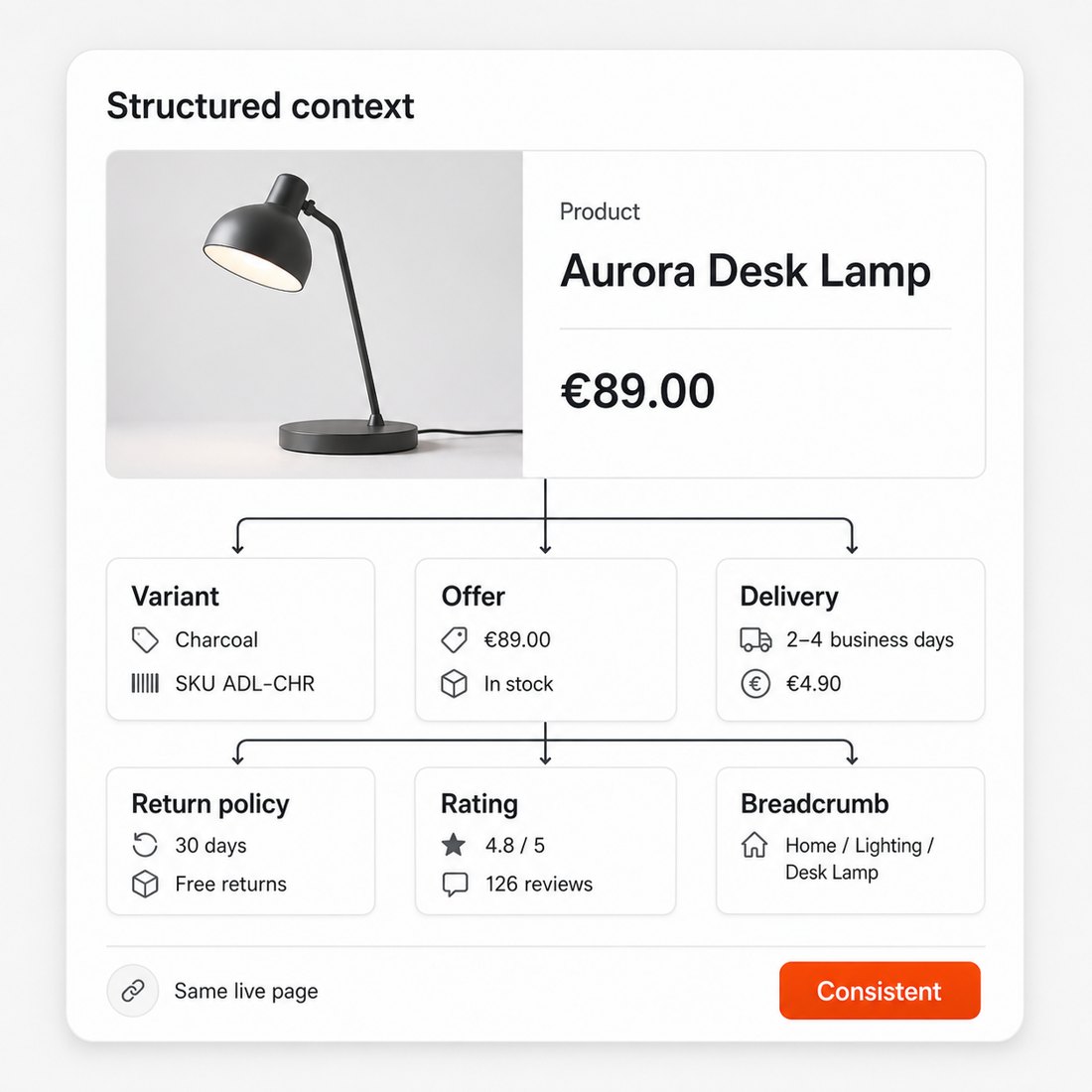
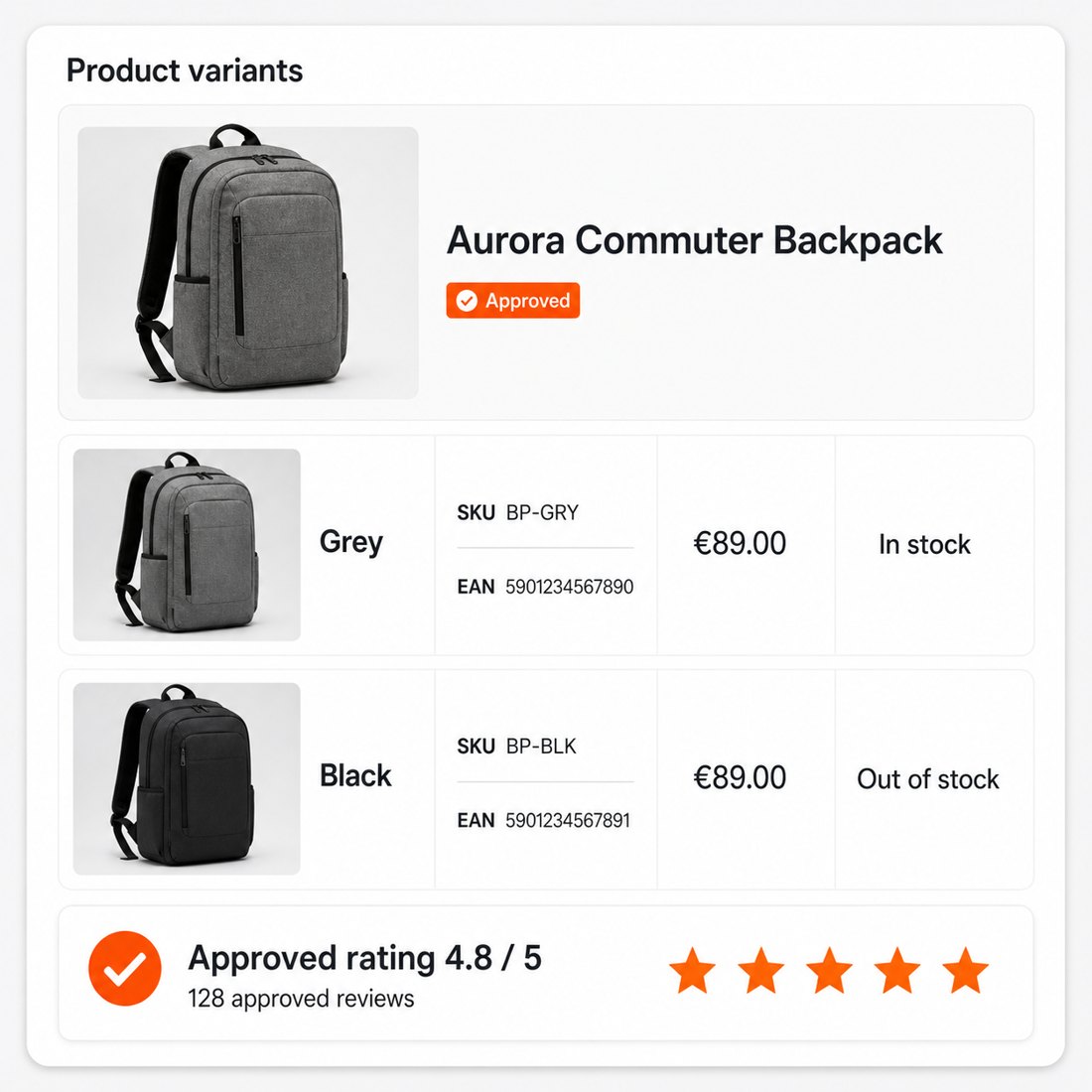
How do products and combinations remain unambiguous?
Each product receives its name, description, brand, category, all current images, condition, weight and native identifiers from the live catalogue. Its offer uses the current price, currency and stock status, and approved product comments supply the rating and recent reviews.
Combinations are described as grouped variants, each with its mapped attributes, image, reference, barcode, price and availability. Price ranges summarize the family without flattening a size or finish into the parent product, and delivery and return details remain attached to every variant offer.
How do delivery, returns and shop identity travel together?
Offer data includes preparation time, transit time, shipping destination and delivery cost. The return policy carries its window, fee, method and policy address, so a search system receives the same commercial terms that govern the order.
The business is described as the appropriate organization or shop type with its legal and tax details, logo, customer-service contact, postal address, location, opening hours, accepted payments, languages and social profiles. Each storefront therefore presents a recognizable merchant behind the product rather than an isolated price.

Which pages receive their own structured description?
The homepage carries the business and website identity together with on-site search context. Internal pages receive breadcrumb paths, categories become product collections with configurable lists for the current selection, bestsellers and recommendations, and CMS pages become articles with headline, body, dates, publisher and language.
FAQs belong to products, categories, CMS pages or selected addresses. Bulk assisted drafting uses product names, descriptions, features and reviews, then a per-item editor keeps human approval in the workflow. The visible answer block and its search information use the same multilingual content and the same order.
Practical guides carry ordered steps, timing and images, while events carry dates, location, organiser and status. Shared links use their own title, description and image, so page identity remains consistent outside the search result as well.

How are missing facts and duplicate sources caught early?
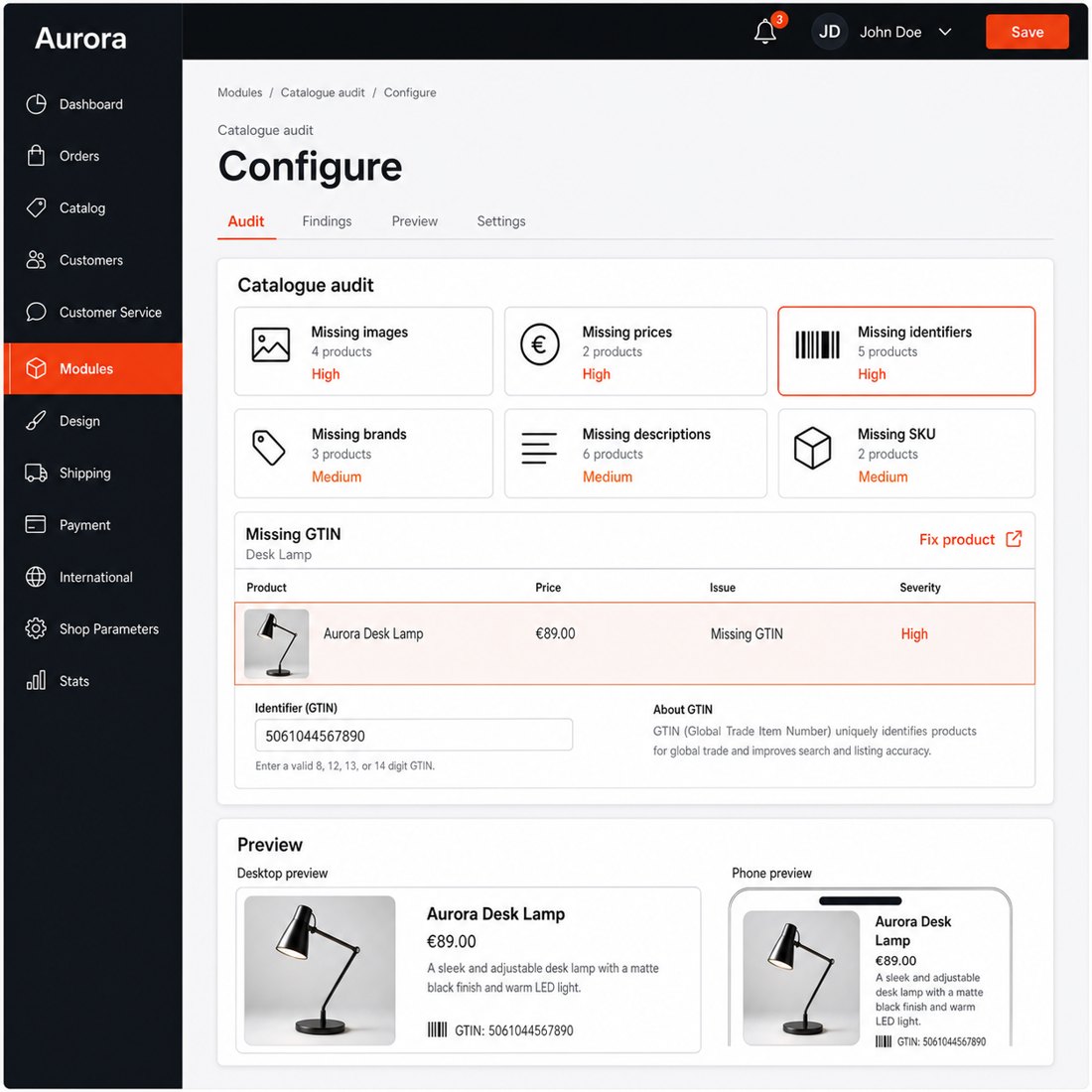
The catalogue audit groups missing images, prices, identifiers, brands, descriptions and combination data by severity, links each finding to its correction and exports the list for team work. Product, category, CMS and homepage previews show both desktop and mobile search-result layouts before publication.
Public-page tests send the selected address to the Google and Schema.org validators and bring the result back into the workflow. The duplicate scanner identifies the source and entity type, while controlled cleanup replaces only overlapping data, preserves unrelated information and records every decision for diagnosis. Prepared output is stored and refreshed automatically after catalogue, review, FAQ, shop, language or setting changes.
What stays under the merchant's control, and what stays with search engines?
Every shop and language in a multistore setup keeps its own identity, policies, page coverage, FAQs and shared-link titles, descriptions and images. Product, category and manufacturer adjustments set exceptional brands, identifiers, conditions and verified rating fallbacks without changing the visible catalogue record.
The module publishes valid, consistent information and keeps competing sources from contradicting it. It does not invent reviews, prices or delivery promises, and it does not guarantee rankings, traffic or a particular search presentation. Crawling, eligibility and final display remain decisions of the search engine.

-
Referencemprseoschemarichsnippets
-
In stock2147483647 Items
-
PrestaShop CompatibilityPS 1.7 – 9.x
-
Pricing ModelOne-time Purchase
-
Module TypeFront & Back-office
-
GDPR RelevantNo
-
Business GoalIncrease Traffic
-
External Account NeededNo
-
Module ComplexityFeature-Rich Module
-
Customer Journey StageAttract Visitors
-
Works With PlatformNo External Platform
What customers say about us
Company reviews
5.0
★
★
★
★
★
(4 reviews)
Loading customer reviews...
No product reviews yet
Be the first to share your experience with this module.
Write a Review
Automatic SEO Schema Rich Snippets adds Schema.org JSON-LD to your PrestaShop store so search engines can better understand your products, categories, CMS pages, breadcrumbs, business details, search page, shipping, returns, and reviews. It uses your live shop data, so prices, stock, images, identifiers, and availability are generated from the current product record.
Have a question about this product?
Our experts are here to help. Ask anything about installation, compatibility, or specifications.
1301
questions
9
categories
2013
building modules since
1.6–9
PrestaShop versions
v1.1.122026-05-27
- Addedcomplete FR/DE/ES/IT/PL translations
- FixedAdd standard infrastructure checks, tag quality/monitoring checks
Loading full changelog...
Works Well With Automatic SEO Schema Rich Snippets
Modules our team genuinely pairs with this one, and exactly why each belongs in the same setup.
Complement
Automatic SEO Schema Rich Snippets is giving your store structured data for products, categories, CMS pages, breadcrumbs and site identity, so the pages crawlers reach are better understood. But schema only matters once a crawler actually reaches the page, and PrestaShop does not guarantee every important URL is easy to discover.
Advanced SEO Sitemap Builder covers that discovery side, generating XML sitemaps across products, categories, CMS pages, brands, suppliers and core pages, with an optional HTML sitemap for shoppers. It works alongside schema rather than depending on it: one helps pages get found, the other helps them be understood.
Together they address both halves of getting a page to perform in search. Your sitemap puts the right URLs in front of crawlers while schema makes those URLs more interpretable once visited, which can support richer search presentation. It is the natural pairing for a store that wants its catalogue both efficiently discovered and clearly described.

Complement
With Automatic SEO Schema Rich Snippets describing your products, categories and CMS pages through structured data, you are helping search engines interpret each page. That interpretation is weakened if several near-identical URLs exist, because the structured signals end up spread across duplicates instead of concentrated on one authoritative page.
Product Canonical Manager handles that consolidation separately, letting you set canonical, noindex, nofollow and hreflang rules per entity or by broader selection from the back office. It does not generate schema; it clarifies which page should carry the search signal, complementing the structured-data work.
The combined effect is clearer, less diluted signals. Schema describes what a page is while canonical rules help ensure that description is attached to the version you actually want ranked, so duplicate-content confusion is reduced and your structured data is working on the primary URL rather than scattered across variants.

Complement
Automatic SEO Schema Rich Snippets covers structured data for products, categories, CMS pages, breadcrumbs and site identity, which is the right scope for a catalogue-focused store. What it does not cover is editorial content: buying guides, advice and announcements that attract earlier-stage search traffic live outside the product tree.
Blog Revolution fills that content gap, keeping native articles, categories, tags, authors, comments and clean blog pages inside the shop so content can attract search traffic and lead readers toward products. It complements the schema module by adding the content surface itself, while schema continues handling the entity types it supports.
Together you grow both depth and structure: the blog brings in readers researching topics around your products, and your product, category and CMS pages carry the structured data that helps them appear richly in search. Each tool stays in its own lane, but the store gains both a content engine and solid structured markup on its catalogue.

Complement
Automatic SEO Schema Rich Snippets adds structured data for products, categories, CMS pages, breadcrumbs and site identity, improving how those pages are described to search. What it does not do is create the underlying review content that often makes product results more compelling to shoppers in the first place.
Reviews & Ratings covers that, adding native moderated ratings, written feedback, optional photo reviews and review criteria for products, categories, CMS pages and the store itself, all kept inside PrestaShop. It is a separate trust-building tool, not a feed into the schema module, and you moderate submissions yourself.
Used together, you build genuine on-site review content where buying decisions happen while your schema module independently handles the structured description of your pages. Shoppers get visible proof in the store and your catalogue pages carry clean structured data, two complementary improvements to how products are both perceived and understood without conflating one tool's job with the other's.
 30 days return right
Easy return - no questions asked
 Plug & Play Modules
Install, set up and take profit
 Dedicated Support First
Priority Help & Satisfaction Over Sales
You might also like

