


Create clean SEO-friendly URLs in PrestaShop with redirects and duplicate URL control


Smart SEO Friendly URL Manager is a module for PrestaShop stores that gives every important page a clear address and keeps previously published links working when the catalogue changes. Starting takes an installation and one guided screen: the module proposes clean defaults, shows their effect and applies only the approved result.
A store address outlives the current product name. Search results, campaigns, bookmarks and links from other sites continue to use it after a rename, a move or a withdrawal. The module preserves that route to the intended page and records the old address, the current destination, the reason for the change, the number of visits and the latest use.
You choose the exact address plan for products, categories, content pages and their categories, brands, suppliers, blog articles, module pages and filtered selections. Each family gets its own pattern, ending and hierarchy. Lowercase conversion, accent removal, special-character cleanup, collision rules and readable product-variant paths keep the result consistent with the catalogue.
Large cleanups remain supervised. Current and proposed addresses appear together before approval, hand-written values stay locked, conflicts are checked across every managed page family, and each language and store keeps its own rules. The redirect manager handles grouped sources, permanent and temporary responses, deliberately removed pages and a missing-address report with reviewed destinations.
The benefits are readable links, preserved campaign and search traffic, safer catalogue migrations, fewer visitors lost after a rename and detailed control without a long setup.
How does every URL change stay under control?
Smart SEO Friendly URL Manager manages the addresses of a PrestaShop store and protects published links with a supervised change process: every large rewrite is previewed, edited and approved before it replaces the current value.
- Published links: old addresses retain a working route to the intended current page and remain visible in a detailed history.
- Address structure: each page family follows its own pattern, hierarchy, ending and collision policy.
- Large changes: current and proposed values sit side by side, while approved hand-written addresses stay locked.
- Redirect work: grouped sources, selected destinations and missing-address reports share one managed workspace.
- Store boundaries: every language and every store keeps an independent address plan.
- Starting and growth: guided defaults begin the work quickly, while detailed controls cover a mature catalogue.

What happens to a published link after a page is renamed?
A change to a product, category, content page, content category, brand or supplier records the previous full address before the new one becomes active. Search results, campaign messages, bookmarks and partner links then reach the intended current page instead of ending at a missing address.
The history shows the source, destination, page family, language, store, reason, response type, active state, visit count and latest visit. A current page always owns its valid address before an older history entry is considered, so an obsolete redirect never takes over a path that has become useful again.
Permanent, temporary and deliberately removed destinations use the selected 301, 302, 303, 307 or 410 response. Each record remains switchable, making a past address both a working route and an auditable part of the catalogue.

How closely does each address follow the catalogue?
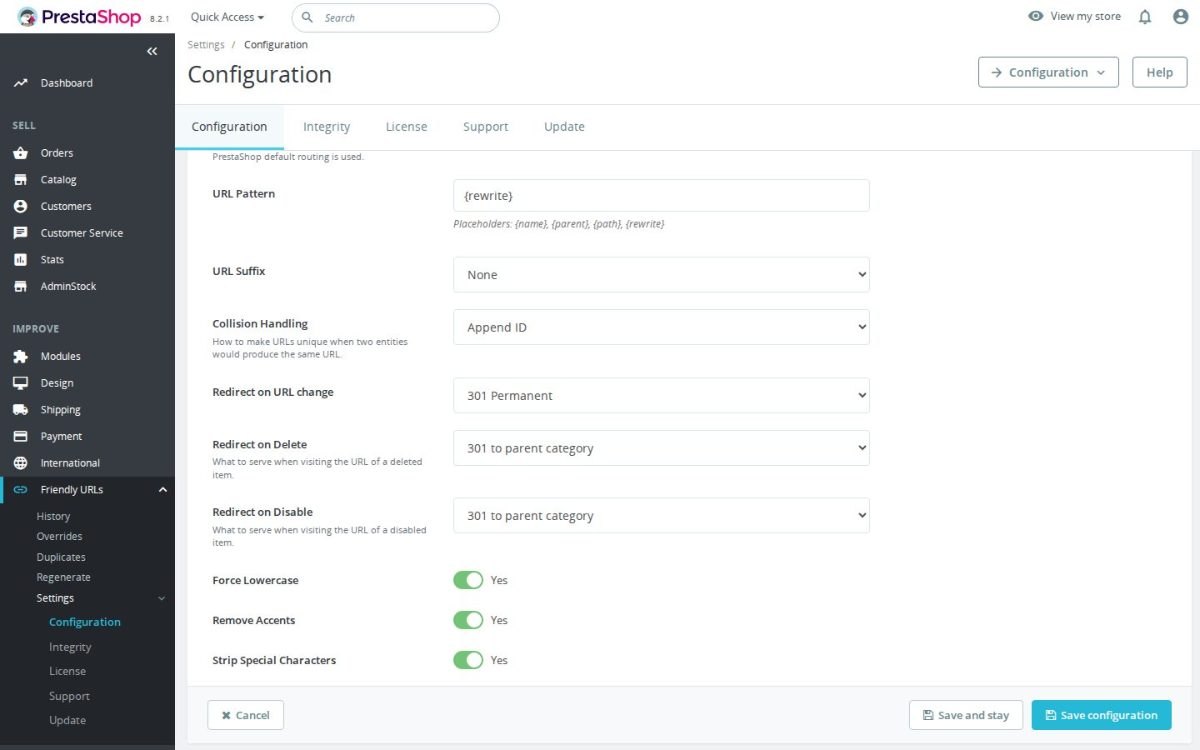
You choose a separate address pattern for products, categories, content pages and their categories, brands, suppliers, blog articles, module pages and filtered selections. The chosen values include names, category paths, brands, references and other useful catalogue information. Each family also has its own ending, with no ending, an HTML ending or a trailing slash.
Product paths include their parent categories when that structure suits the shop. Product variants use no separate address, a readable path such as size and colour, or an anchored selection. Lowercase conversion, accent removal and special-character cleanup keep every language predictable.
When two pages would receive the same complete address, the conflict report identifies every owner and applies the reviewed repair rule. The report covers collisions within one family and between different families, rather than comparing only the last word of the address.
How does a large catalogue change remain reviewable?
The regeneration screen places each current address beside its proposed replacement. Every proposal remains editable before approval, and the final action applies only the reviewed batch. Approved values receive a lock, while earlier locks remain visible and are skipped by later operations.
The same protected process captures the old full address, checks ownership and collisions, refreshes the live destination and writes the history entry before the new value starts serving visitors. Products, categories, content, brands and suppliers all follow that one lifecycle, including changes made directly in the list.
Scheduled conflict checks turn new duplicates into a report with a reviewed repair, instead of silently changing commercial addresses. A carefully chosen product or campaign path therefore survives later bulk work unchanged.
Where do campaign links and missing addresses lead?
The redirect manager sends an exact old path to a product, category, content page, brand, supplier or chosen address. Several campaign paths share one grouped destination, and an entity destination follows its current live address after a later rename. Language and store remain attached to every rule.
The missing-address report records unresolved requests with their path, store, language, number of visits, latest visit and available context. You choose a reviewed destination for a genuine old link, or retain the missing-page response when no honest replacement exists. Unknown paths are never pushed indiscriminately to the homepage.
This creates a practical work queue: valuable broken links receive a precise repair, intentionally removed pages return 410, and unrelated requests remain genuine missing pages.

How little work starts it, and how deep does control go?
The guided starter screen proposes clean defaults for every managed page family and previews the addresses they produce. Approval activates only the chosen plan. The same administration area then exposes patterns, hierarchy, endings, product variants, change policies, history, redirects, conflicts and integrity checks.
Every store and language holds its own settings, ownership and history. Disabling the module or one page family restores the corresponding standard PrestaShop addresses in one controlled transition, while existing published paths keep their deliberate route. When the wider SEO suite takes responsibility, ownership passes to it without two systems competing for the same address.
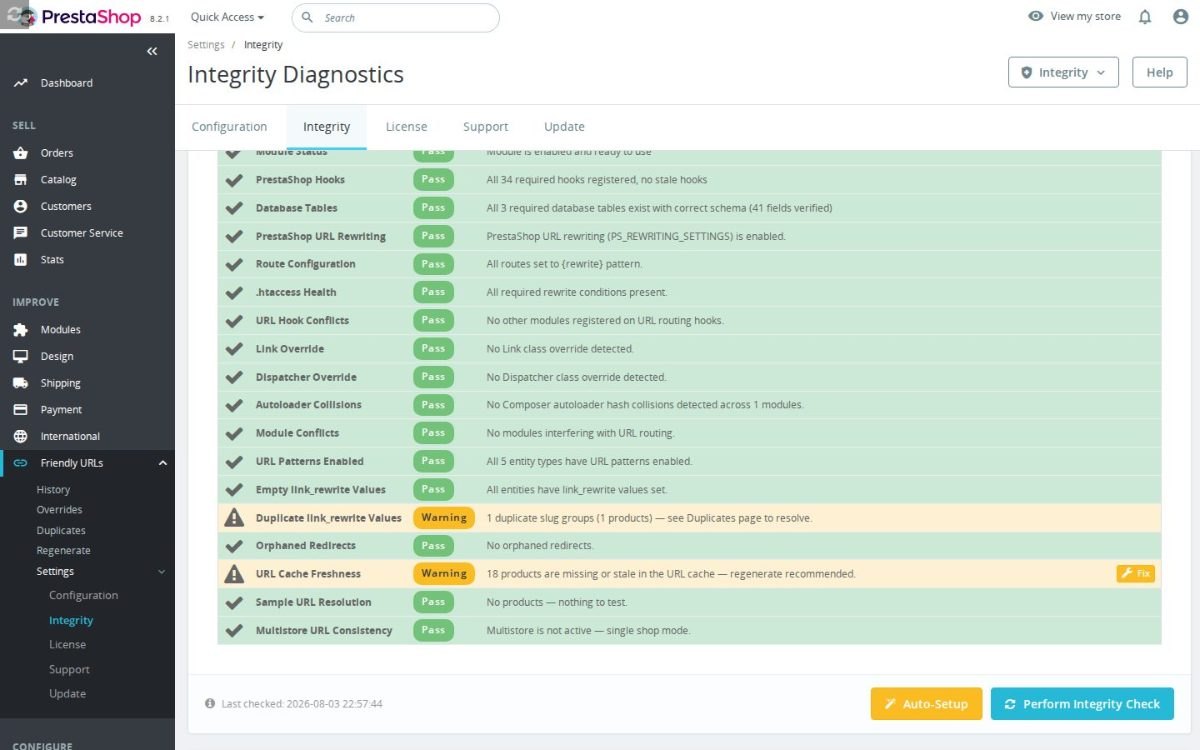
Integrity checks cover the stored structures, address ownership, rewriting, route rules, conflicts, orphaned redirects, stale records and a sample live address. The result is a quick start for a new shop and the depth required for a multilingual catalogue with years of published links.
-
Referencemprseofriendlyurlmanager
-
In stock2147483647 Items
-
PrestaShop CompatibilityPS 1.7 – 9.x
-
Pricing ModelOne-time Purchase
-
Module TypeFront & Back-office
-
GDPR RelevantNo
-
Business GoalIncrease Traffic
-
External Account NeededNo
-
Module ComplexityFeature-Rich Module
-
Customer Journey StageAttract Visitors
-
Works With PlatformNo External Platform
What customers say about us
Company reviews
5.0
★
★
★
★
★
(4 reviews)
Loading customer reviews...
No product reviews yet
Be the first to share your experience with this module.
Write a Review
Clean, readable URLs make store pages easier to understand, share, and crawl. Smart SEO Friendly URL Manager removes PrestaShop's numeric URL prefixes and gives you controlled URL patterns for products, categories, CMS pages, manufacturers, and suppliers.
Have a question about this product?
Our experts are here to help. Ask anything about installation, compatibility, or specifications.
1301
questions
9
categories
2013
building modules since
1.6–9
PrestaShop versions
v1.15.72026-05-27
- AddedSymfony kernel.request tab rescue + remove rescueController call
- Addedself-healing infrastructure with automatic diagnostics and repair
- Addedcomplete FR/DE/ES/IT/PL translations
Loading full changelog...
Works Well With Smart SEO Friendly URL Manager
Modules our team genuinely pairs with this one, and exactly why each belongs in the same setup.
Complement
Smart SEO Friendly URL Manager has cleaned up how your store's addresses read, replacing cluttered URLs with patterns shoppers can share and trust across products, categories, CMS pages, manufacturers and suppliers. Clean URLs are easier to share, but they still need to be put in front of crawlers to be discovered efficiently.
Advanced SEO Sitemap Builder handles that, generating XML sitemaps across products, categories, CMS, brands, suppliers and core pages, with an optional HTML sitemap. It complements the URL manager: one shapes how addresses read, the other lists them for search engines, each operating independently.
Together your tidy, readable URLs are also the ones actively surfaced to crawlers. Shoppers get professional links while search engines get an explicit map of those addresses, so the readability work is matched by discovery work and your cleaner catalogue structure is both shareable and efficiently crawled rather than left to be found by chance.

Complement
Smart SEO Friendly URL Manager gives your store readable, shareable addresses, but cleaner URLs do not resolve which of several similar pages should carry the search signal. Duplicate-content confusion is about authority, not legibility, and a friendly URL can still have near-duplicate variants.
Product Canonical Manager covers that, letting you set canonical, noindex, nofollow and hreflang rules per entity or selection so the right page is treated as primary. It complements the URL manager: one improves how addresses look, the other decides which address holds the search weight, each managed from its own back office.
Used together, your clean URLs are also clearly designated as canonical or not, so the readability improvement does not accidentally multiply ranking-eligible variants. Shoppers see tidy links while search engines get a consistent signal about which of those links is authoritative, addressing presentation and consolidation as two separate but complementary jobs.

Complement
Smart SEO Friendly URL Manager makes your store's addresses cleaner and more trustworthy, improving how individual pages present. What it does not do is build the connections between those pages that help shoppers and search engines move through your catalogue and concentrate relevance.
Automatic Internal SEO Linker covers that, turning chosen keywords into controlled internal links across existing content so important products, categories and pages get clearer paths. It complements the URL work: one improves how each address reads, the other improves how pages link to one another, each handled separately.
Together your store gains both readable URLs and a deliberate internal structure. Clean links are easier to share while internal linking guides visitors and crawlers toward the pages you care about, so you are improving both the surface of individual addresses and the navigational and topical relationships between them, with each tool doing its own job.

Complement
Smart SEO Friendly URL Manager produces clean, readable URLs across products, categories, CMS pages, manufacturers and suppliers, which matters even more on a multilingual store where each language has its own addresses. Tidy URLs, though, do not tell search engines which language version suits which audience.
Hreflang Tags Manager covers that, adding alternate-language link tags in the page header using PrestaShop's own URL generation across the same entity types and reading your active shop languages. It complements the URL manager: one shapes the addresses, the other annotates how language versions correspond, each in its own workflow.
Together a multilingual catalogue gets both clean per-language URLs and clear hreflang signalling. Shoppers and crawlers see readable addresses while search engines learn which translated page belongs to which audience, so the presentation work and the language-routing work reinforce each other, with each tool handling a distinct layer of multilingual SEO.
 30 days return right
Easy return - no questions asked
 Plug & Play Modules
Install, set up and take profit
 Dedicated Support First
Priority Help & Satisfaction Over Sales
You might also like


