


Run a full PrestaShop SEO audit of indexability, structured data, linking and content
PrestaShop SEO Audit & Action Plan gives you a specialist review of your live store and a ranked plan of exact fixes. You provide the shop address; read-only access to Google Search Console helps but is optional, and we never need access to your back office; nothing is installed or changed.
The review reconciles pages a crawler reaches, pages Google indexes and the intended PrestaShop settings, exposing gaps that a working storefront does not show.
Each finding includes its cause, example pages, business impact and fix, ordered by severity and effort. Implementation, content writing, link building and ongoing monitoring are outside scope. Delivery takes 3 to 5 business days: a PDF, typically 15 to 30 pages, with 14 days for clarification by email.
Your developer receives an ordered task list with quick wins marked and evidence behind each proposed change.
What does the PrestaShop SEO Audit & Action Plan cover?
PrestaShop SEO Audit & Action Plan is a human audit of a live PrestaShop store that ends in a ranked plan of exact fixes.
- The method: three signals reconciled: crawler access, actual indexation, configuration intent.
- The scope: the PrestaShop-specific traps, from filter addresses to language clusters.
- The report: every finding with cause, real examples, business impact and the exact fix, on a set timeline.
- The order: severity, impact and effort, quick wins marked, cosmetic findings labelled.
- The person: a specialist reading your store, and the stores the audit fits.
- The boundary: how it starts, where it ends, and what happens with the plan.

Why is traffic falling when everything looks right?
Because the three places where the truth lives are normally checked separately. A crawler sees one set of pages, Google's index contains another, and the PrestaShop configuration describes a third, intended, store. Each looks consistent on its own; the damage sits in the differences between them, and no single tool reads all three.
The audit puts the three side by side. A page that is reachable but unindexed, an address that is indexed but was never meant to exist, a setting whose intention the theme silently overrides: these differences are the findings, and they are precisely the ones a back office never displays.

What exactly does the audit examine?
The failure patterns of PrestaShop specifically. Filtered navigation that multiplies addresses until the crawler spends its attention on colour-and-size permutations instead of products. Canonical addresses that point at redirects. Language clusters with a missing default version or an address borrowed from the wrong shop. Categories buried so deep, or so orphaned, that no path leads into them. Valuable pages that quietly dropped out of the index while their thin duplicates stayed.
If you grant read-only access, the reading includes the store's Google Search Console data, so the report speaks about what Google actually did with the pages, not about what theory predicts. Multishop setups, multilingual catalogues and combination pricing are read with the same PrestaShop-specific eye, because that is where the platform hides its subtlest traps.

What does the report look like?
Every finding has four parts: the cause, real example pages from your store, the business impact, and the exact fix, written so a developer implements it directly instead of researching it first. The list is ordered by severity, impact and effort, and the quick wins are marked, so the same day the report arrives, work starts where it pays most.
Just as deliberately, the report says what not to do: warnings that will not move rankings are named as cosmetic. An audit that hides five real problems among a hundred harmless ones wastes the exact budget it was meant to direct.
The plan is delivered as a PDF kept in your client panel, typically 15 to 30 pages depending on findings, within 3 to 5 business days of receiving the store's address.

Who does the work, and which stores does it fit?
A specialist who knows PrestaShop reviews the live store personally. This is the difference between an audit and an export: a checker counts missing meta descriptions, while a person recognises that a layered-navigation setting is feeding the crawler ten thousand near-identical addresses and that this, not the meta descriptions, is why the category pages sank. The conclusions are judgements with evidence, not thresholds with icons.
The audit fits an established store with organic history: traffic that is falling and a catalogue only partly indexed. A brand-new store has no indexed history to diagnose yet; for it, the audit belongs a few months after launch, once Google has taken a position worth examining.

How does it start, and where does the audit end?
The start is minimal: you provide the store's address. Read-only access to Google Search Console helps but is optional; we never need access to your back office. Nothing is installed, no code is changed, and the shop runs untouched while the audit happens.
The deliverable is the diagnosis and the ordered plan. Your own developer executes it item by item, beginning with the marked quick wins, and each completed line has a defined, verifiable outcome: an indexing barrier removed, a trap closed, a signal repaired. Content writing, link building and off-site work sit outside the audit, ongoing monitoring is not part of a one-off examination, and rankings themselves remain Google's decision; what the plan promises is that every change on it has a cause and a checkable result.
A 14-day email window after delivery covers clarification questions about the findings. Implementation help, or a follow-up audit after the fixes ship, is its own separate order.

-
ReferenceSVC-SEO-AUDIT
-
Service typeAudit
-
Turnaround3–5 business days
-
DeliverablePrioritised report + handover call
-
Access neededStore URL; Search Console read-only optional; admin not required
-
PrestaShop versions1.6 / 1.7 / 8 / 9
-
ImplementationQuoted separately
-
NDA / DPAAvailable on request
A prioritised, plain-English SEO action plan for your real PrestaShop store, not a generic crawler checklist.
A specialist audits your live store end to end, indexability, canonicals, hreflang, structured data, internal links, sitemaps and content gaps, then ranks every finding by impact, with the wasted effort called out so you stop spending on things that won't move rankings.
Service type
Audit, diagnosis & plan
Implementation quoted separately
Price
€490 fixed
One-off, per store
Turnaround
3–5 business days
From access + intake
Deliverable
Prioritised report + walkthrough call
Access needed
Store URL; Search Console read-only optional
Admin not required
PrestaShop
1.6 / 1.7 / 8 / 9
Multistore & multilingual
Crawlability & indexability
What Google can actually reach and keep, and what's quietly wasting crawl budget.
- Indexable vs blocked pages,
noindexand robots directives - Faceted-navigation and parameter URL crawl traps
- Orphan pages and crawl-budget leaks specific to PrestaShop
Canonicals, hreflang & duplication
Where signals conflict across shops, languages and paginated/faceted URLs.
- Canonicals across faceted, paginated and parameter URLs
- hreflang correctness for multistore / multilingual
- Duplicate-content patterns from combinations and filters
Structure, metadata & content
The on-page foundations that decide how pages are understood and ranked.
- Category/product metadata, headings and structured data
- Internal-linking depth and template-level issues
- XML sitemap coverage, errors and stale URLs; content gaps
How it works
-
Intake Day 1You share the store URL, languages, shops and the symptoms you're seeing.
-
Specialist review Days 2–4We compare crawl, index and configuration signals on your real store, against your exact PrestaShop version, theme and module stack.
-
Prioritisation Day 4Every finding is scored by severity, business impact and fix effort, with quick wins flagged.
-
Handover Final dayYou get the report and a short walkthrough call (or thread) to align your team.
What's included, and what's not
This is diagnosis and a prioritised plan. It is honest about its boundaries.
Included
Full technical review, prioritised findings, fixes & roadmap, handover call
Not included
Implementation, content writing, link building
Quoted separately, honestly
No guarantee
We never promise rankings
We promise an honest, actionable plan
Privacy
NDA / DPA available on request
No data retained unless you ask for a backup
Evidence-based, not a synthetic score
Every major finding names the affected URL pattern, the observed problem and the expected outcome, e.g. Layered-nav URLs indexed → Critical / High impact / Low effort → canonical to base category and block the crawl trap. We call out false positives (generic checker warnings, synthetic scores that contradict field data) so you don't pay to fix non-issues.
Related services
Order this audit €490 fixed · report + walkthrough in 3–5 business days
Is my data safe? GDPR / NDA?
Yes. We're an EU company (Tychy, Poland). NDA and DPA are available on request, and we don't retain your data unless you specifically ask us to keep a backup.
What if I'm not happy?
See our refund policy in the knowledge base. The report is built to be genuinely useful, specific to your store, not a template.
Do you need admin access?
No. The audit runs on your store URL, with optional read-only Search Console access. If deeper checks help, we tell you exactly what to grant and how to revoke it afterwards.
What does the PrestaShop SEO Audit actually check?
The PrestaShop SEO Audit examines your real store and your actual Search Console data, rather than running a generic crawler checklist that ignores how PrestaShop is built. The goal is to find the issues that genuinely move organic traffic on a PrestaShop catalogue, and to understand why they are happening in your specific shop, theme and module stack.
Indexability
We confirm that the pages that should rank are actually eligible to rank. That means checking your robots.txt rules, noindex directives, and canonical correctness across products, categories, CMS pages and paginated lists. PrestaShop is notorious for generating crawlable URL variations, layered-navigation filters, sort parameters, ?search_query= and attribute combinations. That can bloat the crawl budget or split signals. We compare what you submit against what Google has actually indexed, so submitted-vs-indexed gaps surface clearly.
Structured data
We validate your Product, Offer, BreadcrumbList and Organization JSON-LD against real rich-result requirements, not just a syntax checker. Missing price, availability or review fields commonly stop product results from showing enhanced listings, and PrestaShop themes vary widely in how completely they emit this markup.
Internal linking
We map orphan pages, weak category cross-linking and how link equity flows through the catalogue. Strong internal linking is one of the most controllable ranking levers on a large store, and it is frequently neglected when categories grow organically.
XML sitemaps & hreflang
We review your XML sitemaps for submitted-versus-indexed gaps and, on multilingual shops, verify that hreflang signals are reciprocal and correct so the right language and country version is served.
Content gaps
Finally, we identify thin pages, duplication and missed keyword intent. Places where the page exists but does not satisfy what searchers actually want.
Because a specialist reviews your shop and your Search Console property directly, every finding reflects your actual situation rather than a theoretical best-practice list.
What do I receive at the end of the SEO Audit?
At the end of the SEO Audit you receive a clear, prioritized action plan written in plain English. Not a 200-row spreadsheet dump that leaves you guessing where to start. The deliverable is built to be acted on, whether you do the work yourself or hand it to a developer.
For each issue we set out three things explicitly:
- What is wrong. The specific problem, described in terms you can recognise in your own shop.
- Why it matters for traffic, the practical reason this affects indexation, crawling or rankings, so you understand the stakes rather than just a label.
- Exactly what to fix first, the concrete next step, not a vague recommendation.
Findings are ranked by impact versus effort. That means the high-leverage, low-effort items are clearly separated from the larger structural work, so you can act on the quick wins immediately and schedule the rest with confidence. This ordering is deliberate: on a busy store, knowing the sequence is often more valuable than the raw list of problems.
Where it genuinely helps, we name the specific PrestaShop element involved, the exact configuration setting, controller or template that needs attention. For example, if a canonical issue traces back to how a category controller builds its URLs, or a structured-data gap lives in a particular .tpl, we point to it directly. That precision lets your developer move straight to the fix instead of rediscovering the diagnosis.
The plan is written so it stands on its own. You are never left with findings you cannot interpret, and there is no obligation to engage anyone further to make sense of it. It is a document you can execute against directly.
How long does the SEO Audit take, and how do we start?
Getting started is intentionally light on your side. We begin with a short scoping step to confirm the things that shape the whole review: your goals, your target markets, and the languages your shop serves. This matters because SEO priorities differ significantly between, say, a single-language domestic store and a multilingual catalogue where hreflang and country targeting are central concerns.
Once that is agreed, we run the review against your live shop, using your Search Console data if you choose to share it. Working on the real store, rather than a staging copy or a synthetic crawl, is what lets the findings reflect your actual indexation and real URLs, with real query data added when available.
How long it takes
Most audits are completed quickly once we have the shop address. We confirm the expected timing with you after the short scoping step, because the realistic turnaround depends on the size of your catalogue and the scope you choose. A focused single-language store is quicker to review than a large multilingual one.
What you need to prepare
Nothing technical. You do not need to assemble reports, export data or change any settings in advance.
We need the shop address. Read-only access to your Search Console property helps us see how Google currently crawls and indexes the site, but is optional. We never need access to your back office; nothing is installed or changed.
3 to 5 business days from receipt of the shop address, depending on catalogue size and the number of shops/languages.
Do you also fix the SEO problems, or just report them?
The SEO Audit itself is a diagnosis. The deliverable is a prioritized plan that you, or any competent developer, can act on independently. We deliberately write it so it stands alone: each issue explains what is wrong, why it matters and what to do, with the specific PrestaShop setting, controller or template named where that helps. You are not left dependent on us to interpret the results.
That said, plenty of store owners would rather not implement the fixes themselves, and if you'd like us to do the work, we can. There are two broad routes, and we choose whichever genuinely fits the problem:
- Our own PrestaShop modules. Where a recurring or structural issue is best solved by a proper tool (for example managing canonicals, sitemaps, structured data or redirects at scale), and a module is the right long-term answer rather than a one-off edit.
- Hands-on remediation work, direct changes to templates, configuration or code where a targeted fix is what is needed.
Any implementation work is quoted separately, once the audit has made the priorities clear. We think that is the honest order to do it in: you see the diagnosis first, understand what actually needs doing, and only then decide whether to hand the work back to us or take it elsewhere.
There is no obligation to buy anything else. The audit is complete and useful on its own. The plan is yours to execute however you prefer. Offering implementation is a convenience for owners who want one team to carry the work through, not a condition of the audit being worthwhile.
 30 days return right
Easy return - no questions asked
 Plug & Play Modules
Install, set up and take profit
 Dedicated Support First
Priority Help & Satisfaction Over Sales
Who builds and maintains this module
Built and maintained by David Miller and mypresta.rocks. David Miller has worked with PrestaShop since 2013, and the company behind this shop has been registered since 3 December 2018. Every module in this catalogue is our own work, so your questions to support reach the people who wrote the code. The changelog on this page lists every update with its date.
More modules








Compliance & Legal
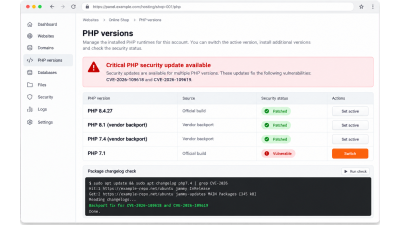
PHP2Shell: what PrestaShop shops should do about CVE-2026-109618 and CVE-2026-109619, even when they cannot upgrade
News & Updates
What's new at mypresta.rocks: September 2026
News & Updates
What's new at mypresta.rocks: August 2026

News & Updates
PrestaShop 9.2 native One Page Checkout: what it does and when you need more

News & Updates
Introducing Expert Services: PrestaShop audits before you buy another module

News & Updates