


Audit your PrestaShop hosting across PHP, cache, CDN, TLS, backups and uptime
PrestaShop Hosting & Infrastructure Audit reviews the foundation beneath your shop and delivers a specialist's written verdict: migrate or improve the current host. You provide hosting and back-office access; the service is an assessment, not server work.
A hosting plan chosen for a smaller catalogue needs reassessment as traffic grows. The review examines backup recoverability, the request path, database, storage and email delivery against your actual workload.
For 290 euro, you receive a ranked report, typically 10 to 20 pages, within 3 to 5 working days. Findings include evidence, fixes, effort and verification. Migration, configuration changes and provider fees are excluded; clarification by email lasts 14 days. The service sells no hosting and takes no referral fees.
You decide whether to move with evidence about capacity and recovery already in hand.
What does the PrestaShop Hosting & Infrastructure Audit cover?
PrestaShop Hosting & Infrastructure Audit is an independent, one-off examination of everything your shop stands on, ending in a ranked report and a clear verdict.
- Whether your backups actually restore: the question answered first, before an incident asks it.
- What the specialist examines: the full path a request travels, layer by layer.
- Whether this host fits this store: capacity judged on your real catalogue and traffic.
- Move or fix: an answer from someone with nothing to sell you.
- What you receive: the report, the verdict, the timeline and the fixed price.
- Where the audit ends: the boundary between the verdict and the work after it.

Does your backup actually restore?
Nobody finds this out on a calm day. The answer arrives during an incident, with the shop down and the last copy of unknown quality. The audit reverses that order: it judges whether what you back up could realistically bring a clean store back, which is a different question from whether backup files exist somewhere on a disk.
The same lens is applied to everything that only matters when things go wrong: what happens when this one server dies, which single points of failure would take the shop down with them, and what the honest recovery time would be. A store that survives its worst day is a configuration decision made in advance, and this section of the report is that decision written down.

What does the specialist actually examine?
One request, followed the whole way. From the delivery layer in front of the shop, through the secure connection your visitors open, the web server, the application, the database and the disk underneath it. At each layer the question is the same: is this doing its job for a store of this size, or is it quietly the reason the shop is slow at seven in the evening?
Along that path the audit checks whether the shop remembers finished work or repeats it on every visit, reviews database settings that were fine for two hundred products and throttle twenty thousand, and looks at whether your order and account emails actually reach inboxes rather than spam folders. Fit and resilience are the measures, not benchmark numbers for their own sake.

Is this host still enough for this store?
The answer depends on the store, so the audit refuses generic spec sheets. Capacity is judged against your actual catalogue and your actual traffic: a small store on solid shared hosting is often perfectly fine, and the report says so; the same plan under a large catalogue and a paid-traffic peak is not, and the report says that too, with the evidence attached.
Any provider setup is assessed, from shared hosting through private and cloud servers to dedicated machines, multistore and multilingual included. The result is a judgment about the store you run, not the store a pricing table imagines.

Should you migrate, or fix what you have?
The most expensive mistake in hosting is migrating for the wrong reason. When the real cure is switching on a memory layer, raising one limit or properly using the delivery service you already pay for, a migration buys risk, downtime and a new monthly bill to solve what a setting would have solved. The audit says so plainly, and just as plainly says when the host genuinely cannot deliver what your catalogue needs.
The recommendation is trustworthy for a structural reason: this service sells no hosting and takes no referral fee from anyone. The only incentive is to point you at the cheapest reliable answer, which is frequently a change on the server you already have.

What do you receive, and where does the audit end?
A written report, ranked before described: the first thing you read is what to do first. Every finding follows the same discipline, the symptom, the evidence it was drawn from, why it happens on PrestaShop, the fix, the effort, and how to confirm it worked, written so a developer acts without asking a follow-up question. Your version names your store, your addresses and your modules, not placeholders, and it closes with the backup and recovery judgement and the written verdict: migrate, or fix what you have, with the evidence for it attached. The report is typically 10 to 20 pages and arrives within 3 to 5 working days of receiving hosting access, a control panel or read access to the server, together with access to the store's back office. The price is 290 euro, fixed.
The audit is the assessment and the plan, not the execution. It does not move your store, reconfigure your server or sign you up with any provider; applying the changes or carrying out a migration is scoped separately and honestly, including the honest version where staying put with better configuration beats moving. Performance work inside the PrestaShop application itself is the separate Performance Audit, a live outage is a rescue job rather than a planned examination, and any hosting fees or plan upgrades the report recommends are settled between you and the provider.
The report is yours to hand to any developer or host, and a 14-day email window covers clarification questions about the findings.

-
ReferenceSVC-HOSTING-AUDIT
-
Service typeAudit
-
Turnaround2–4 business days
-
DeliverableInfrastructure health report + handover call
-
Access neededHost/stack details; control-panel read access optional; admin optional
-
PrestaShop versions1.6 / 1.7 / 8 / 9
-
ImplementationQuoted separately
-
NDA / DPAAvailable on request
A vendor-neutral infrastructure health check: fix, change or move, with the trade-offs spelled out.
We assess your real hosting and stack against what PrestaShop needs at your catalogue size and traffic. The report separates configuration fixes from plan changes and migrations, because the cheapest reliable answer is often not a new host.
Service type
Audit - infrastructure diagnosis & plan
No hosting resale
Price
€290 fixed
One-off, per store
Turnaround
2-4 business days
From host details + access
Deliverable
Infrastructure health report + handover call
Access needed
Host/stack details; control-panel read access optional
PrestaShop
1.6 / 1.7 / 8 / 9
Any host or theme
Server resources & runtime
Whether the store has enough headroom and a sane PHP/database foundation.
- CPU, RAM, disk type, storage headroom and peak-traffic fit
- PHP version,
memory_limit,max_execution_timeand runtime configuration - MySQL/MariaDB version, tuning and database constraints for catalogue growth
Cache, CDN & transport
The layers that should remove repeated work and deliver assets reliably.
- OPcache, Redis and full-page cache presence and effectiveness
- CDN, image/static offload and whether edge caching actually works
- TLS certificate chain, HTTP/2 or HTTP/3, security headers and transport health
Resilience & recovery
What happens on the bad day, not just under normal traffic.
- Backup coverage, frequency, storage location and restore testing
- Uptime history, single points of failure and failover options
- Fix/change/move decision based on likelihood, impact and effort
How it works
-
Intake Day 1You share host/provider, plan, PHP version, server specs, PrestaShop version and symptoms.
-
Assessment Days 1-3We review resources, PHP/DB, cache layers, CDN, TLS and backup posture against PrestaShop's real needs.
-
Recommendation Day 3Each gap is mapped to fix, change or move, with cost/risk trade-offs and quick wins identified.
-
Handover Final dayYou receive the infrastructure health report and a walkthrough of priorities.
What's included - and what's not
This is diagnosis and a prioritised plan. It stays honest about the boundary between finding the work and doing the work.
Included
Specialist review, prioritised findings, concrete fixes, roadmap and handover
Not included
Implementation, remediation, rebuilds, migrations or campaign management
Quoted separately when useful
No guarantee
No rankings, scores, uptime, approval or conversion promises
Only an honest, evidenced plan
Privacy
NDA / DPA available on request
Least-access review; no data retained unless you ask
Reliability risks ranked by real impact
A sample matrix can include: Backups never restore-tested - Resilience - Low likelihood / Total impact - schedule and verify off-site restores. Other rows include no Redis on a busy store, PHP two versions behind, old TLS/no HTTP/2, or a single server with no failover.
Related services
Order this audit €290 fixed · infrastructure verdict in 2-4 business days
How do you decide fix vs change vs move?
Each finding is scored by likelihood, impact and effort. Configuration wins when it closes the gap reliably.
How long does it take?
Typically 2-4 business days from receiving host details and any read access.
Do you need server access?
The core assessment can start from host and stack details. Read access to the control panel or server makes cache, TLS and backup checks stronger.
What does the PrestaShop Hosting & Infrastructure Audit cover?
The PrestaShop Hosting & Infrastructure Audit assesses your hosting against real-world store load, how your shop behaves under actual traffic and admin activity, rather than the spec-sheet promises in a hosting plan. A “fast” server on paper can still deliver slow pages once a full PrestaShop catalogue, modules and back-office tasks are running on it. We examine the layers that actually determine speed, stability and resilience:
- PHP version & server resources, CPU, memory and limits versus your traffic. We check whether your PHP version is current and supported, and whether memory limits, execution time and worker capacity match the load your store really sees.
- Cache layers, OPcache, Redis, full-page cache and how they're configured. Misconfigured or absent caching is one of the most common causes of slow PrestaShop pages, and we verify each layer is present and doing its job.
- CDN & edge, delivery, cache hit-rates and origin protection. We look at whether static assets and pages are served from the edge, how often the cache is actually hit, and whether your origin is shielded.
- TLS / HTTP, certificate, HTTP/2-3 and security headers. Outdated protocols and missing headers cost both performance and safety.
- Backups, failover & uptime. Whether you could survive an outage or a bad deploy. We assess whether backups exist, are recent and are actually restorable, and what happens when something fails.
Why it matters
Hosting sits underneath everything else: no amount of front-end optimisation rescues a store on an undersized or badly configured server. PrestaShop in particular is sensitive to PHP configuration, caching and database performance, so small infrastructure gaps surface as slow category pages, sluggish admin, and lost sales during traffic spikes. This audit is for owners who suspect their host is part of the problem, or who simply want to know, honestly, whether their current setup can carry where the store is heading.
Will you recommend a specific host or move my store?
The audit is deliberately vendor-neutral. Our job is to tell you, honestly, whether your current hosting fits your traffic and where it falls short, not to steer you toward any particular provider. You are never pushed into changing host to “pass” the audit, and there's no hidden referral agenda behind the recommendations.
How it works
- We assess what you have first, the audit measures your existing setup against your real traffic and store size, so the starting point is always “does this host fit you,” not “which host should we sell you.”
- If a migration is genuinely warranted, we explain why. We set out the specific reasons your current hosting falls short and what to look for in a better fit, so you can evaluate options on the merits.
- The move is separate, scoped work, if you decide to migrate, we can carry it out as its own clearly defined engagement. It is never bundled into the audit or used as a condition of it.
Why it matters
PrestaShop migrations carry real risk, PHP and database version mismatches, broken module dependencies, cache and URL configuration, and downtime if cutover isn't planned carefully. That's exactly why the recommendation to move (or not to move) has to be honest and independent of any sales motive. A vendor-neutral audit means you can trust the verdict: if staying put is the right call, we'll say so; if moving is justified, you'll understand precisely why and what a safe migration involves.
This suits owners who want a straight answer about their hosting without the usual pressure to switch. You get clarity on whether your host is fit for purpose, and full control over what, if anything, you do next.
We often recommend configuration changes on the current host.
Server work is also scoped separately if you want us to carry it out.
What do I receive from the Hosting Audit?
You receive a prioritized, plain-English plan to make your store faster, safer and more resilient, with clear guidance on what to change at the hosting level and, just as importantly, what's actually worth the cost. It's written so a non-technical owner can understand the trade-offs and a technical team can act on them.
What's in the deliverable
- Specific, ranked actions, from configuration fixes (PHP settings, cache layers, headers) to larger structural changes, ordered so the highest-impact, best-value items come first.
- Honest cost framing. We separate the changes that pay for themselves from the ones that are nice-to-have, so you don't over-invest in infrastructure your store doesn't need yet.
- A clear verdict on your current host, if your hosting is genuinely holding you back, we say so plainly and explain what a better setup looks like for your size of store, rather than leaving you to guess.
Why it matters
Infrastructure decisions are easy to get wrong in both directions: paying for capacity you'll never use, or limping along on a host that throttles every busy day. The plan is designed to cut through that, concrete, ranked and matched to your actual traffic and catalogue size. Because it's framed in plain English with the reasoning attached, you can make confident decisions about where to spend and where to leave well enough alone.
It suits store owners who want clarity before committing budget. Whether that's tuning the host they have or understanding what to look for in a better one. You finish with a defensible roadmap rather than a sales pitch.
 30 days return right
Easy return - no questions asked
 Plug & Play Modules
Install, set up and take profit
 Dedicated Support First
Priority Help & Satisfaction Over Sales
Who builds and maintains this module
Built and maintained by David Miller and mypresta.rocks. David Miller has worked with PrestaShop since 2013, and the company behind this shop has been registered since 3 December 2018. Every module in this catalogue is our own work, so your questions to support reach the people who wrote the code. The changelog on this page lists every update with its date.
More modules











Compliance & Legal
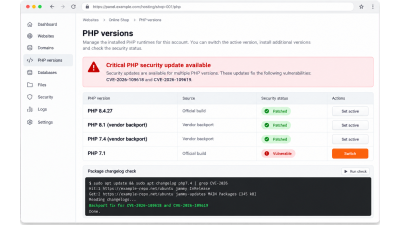
PHP2Shell: what PrestaShop shops should do about CVE-2026-109618 and CVE-2026-109619, even when they cannot upgrade
News & Updates
What's new at mypresta.rocks: September 2026
News & Updates
What's new at mypresta.rocks: August 2026

News & Updates
PrestaShop 9.2 native One Page Checkout: what it does and when you need more

News & Updates
Introducing Expert Services: PrestaShop audits before you buy another module

News & Updates