


How to respond to negative reviews (and recover)
A while back, a fire tore through a warehouse we depend on. Not ours, a fulfilment partner's, but the effect on our customers was the same: orders stalled, promised dates slipped, and for the better part of a month things simply didn't ship on time. The fire was the partner's; the customer outcome was ours. The reviews arrived exactly as you'd expect: a run of one- and two-star ratings on Google and Trustpilot, written by people who were, frankly, right to be annoyed.
The warehouse is back. The delays are gone. The reviews are still there. If you've ever watched a bad stretch calcify into a permanent star rating, this article is the playbook we wish we'd had on day one, how to respond to negative reviews, how to recover a rating after a crisis, and why trying to erase every legitimate bad review usually backfires.
A note on the examples below: the reviews and replies shown here are anonymized reconstructions, real situations, with identifying details and wording changed.
The instinct is to fight it. Don't.
The first reflex is to treat every negative review as a removal problem. Don't. Report a review only when you can point to a specific policy breach, fake, off-topic, abusive, conflict-of-interest, and otherwise fix the underlying issue and reply. Arguing in the replies or chasing takedowns you can't justify just makes the next shopper see a defensive store instead of an unlucky one.
Here's the reframe that matters: a negative-review reply has two audiences. The customer who may still need a remedy, and the future shoppers judging how you handle it. Resolve the first person's problem; write the public reply so the next hundred can see what you did. Handled that way, a negative review becomes some of the most reassuring evidence on your review profile.
Responding isn't optional anymore, the numbers
If replying to reviews feels like busywork, the data disagrees. In BrightLocal's 2026 local consumer survey of 1,002 US adults, 80% said they're likely to use a business that responds to every review, while 42% are unlikely to use one that never replies. Around 89% expect owners to respond at all, and 81% expect a reply within a week. That measures stated likelihood for local businesses, not observed ecommerce conversion, but the direction is unambiguous: silence can reduce the very consideration you're trying to earn. An unanswered one-star doesn't just sit there; it tells every future visitor that nobody's home.
A wall of five stars can be a red flag
Shoppers have gotten good at spotting fakes, and the tell isn't the score, it's the shape. A store with hundreds of reviews and a flawless, unbroken five-star record can look less trustworthy; it can look staged. Many established, well-run businesses still have off days, difficult customers, and the occasional genuinely dropped ball, and their ratings may show it: mostly good, weighted to four and five stars, with a visible tail of lower ones that got answered like adults. A perfect spike is a reason to look closer, not proof of anything on its own.
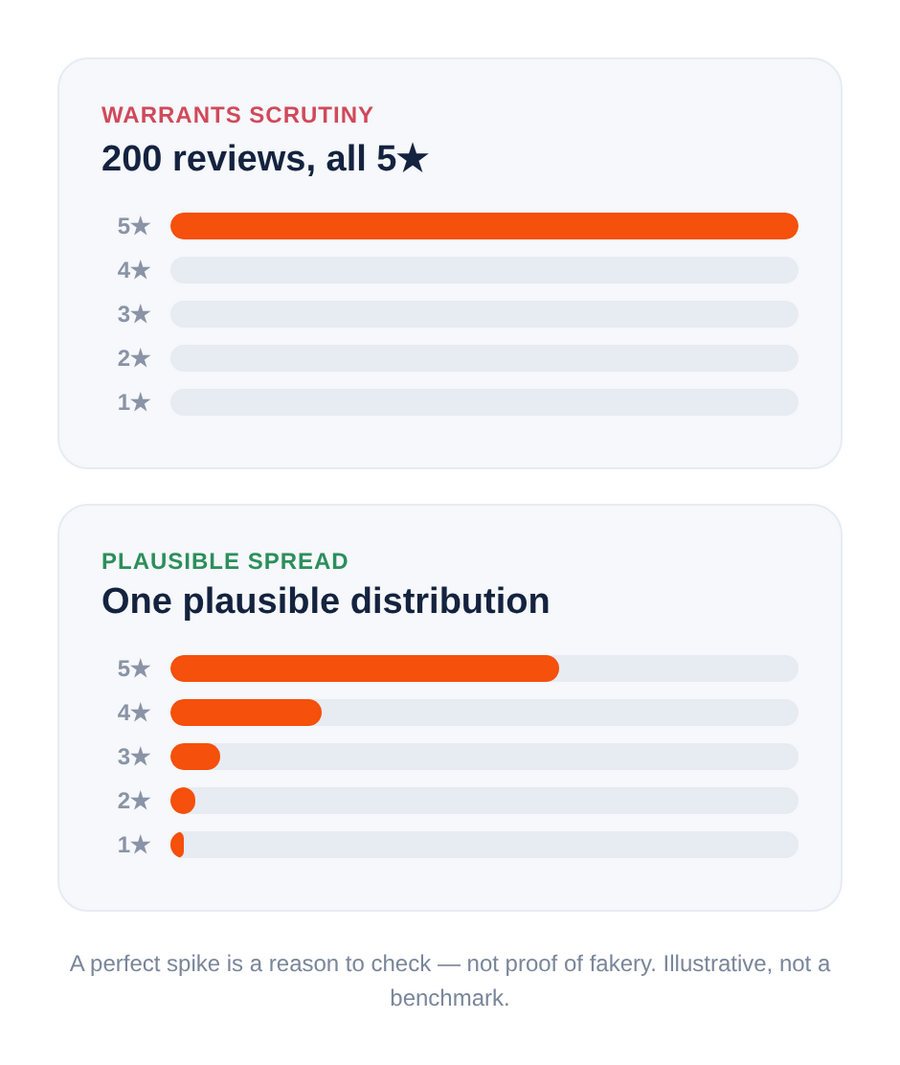
We wrote a whole piece on why that pattern matters, how to spot fake reviews, and the lesson runs both ways. If you're tempted to scrub your two-stars into oblivion, you risk creating the sort of profile a savvy buyer will scrutinize. A few well-handled negatives make the overall profile more credible; they don't prove any particular positive review is genuine, they're a trust signal, not proof, showing how a business behaves when something goes wrong.
The anatomy of a good reply
Most bad responses fail the same way: they argue, they excuse, or they copy-paste. A good one is short, specific, human, and written to the reviewer with the wider audience in mind. The difference is stark when you see it side by side:
| ❌ The reply that loses trust | ✅ The reply that earns it |
|---|---|
| "We have no record of this order and our shipping times are clearly stated on the website. Please contact us if you have an issue." | "You're right, this took far too long, and that's on us. A supplier disruption held up a batch of orders and the backlog is now cleared. Please email me at hello@… with your reference and I'll review the delivery charge and next steps today. Marta, customer care" |
| Defensive, blames the customer, points to the fine print, no ownership, no name. | Owns it, explains without excusing, moves the specifics to a private channel, signed by a real person. |
The rules underneath the good version:
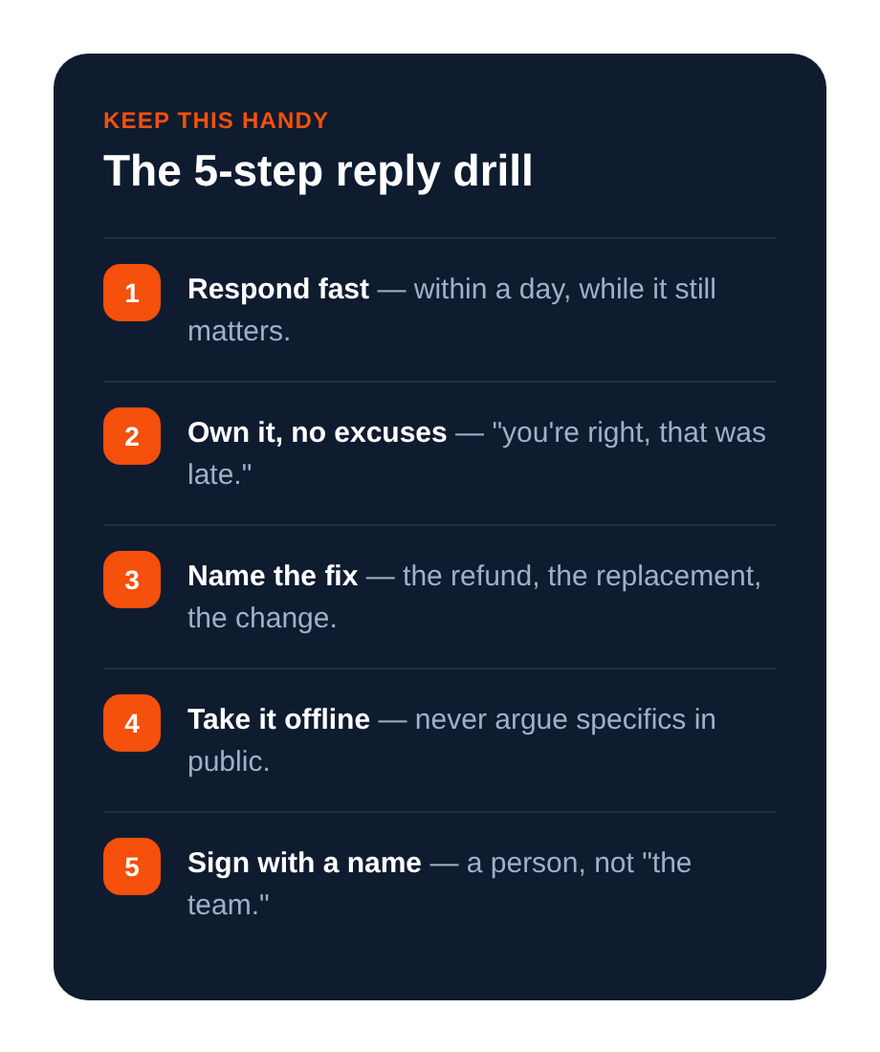
- Respond quickly, within a day or two, while it still matters. If you are already late, reply anyway and acknowledge both the original issue and the delayed response.
- Own it without excuses. "You're right, that was late" beats a paragraph of context every time. Explain the cause in one sentence, don't litigate it.
- Be specific about the fix, the refund, the replacement, the process change. Vague apologies convince no one.
- Take the details offline. Offer a direct channel; never confirm order specifics or argue account history in public.
- Sign it with a real name. "The team" is a wall; a person is a hand extended.
One important exception. For a review that alleges injury, an unsafe product, discrimination, fraud, a data breach, chargeback activity, or threatened litigation, do not improvise and do not admit unverified liability. Preserve the review, acknowledge the concern neutrally, move it to a secure channel, and escalate to the incident owner, your insurer, counsel, or DPO as appropriate. And whatever the case, a public reply is not "case closed": every remedy you promise in public should become a private ticket with an owner, a due date, and proof it was finished.
Templates for the reviews you'll actually get
The five rules are easy to nod along to and hard to apply at 9pm when you're staring at a one-star. Here are starting points for the negatives that actually land. Adapt each to the situation, never paste verbatim, keep the private details private, and always sign with a name.
The late or missing delivery
The most common, and often straightforward to resolve. Own the outcome, name the cause in one line, move the fix to a private channel.
"You're right that this took far too long, and I'm sorry, that's on us, not you. A supplier disruption held up a batch of orders. It's sorted now. If yours was affected, email me at [address] with your reference and I'll review the delivery charge today. [Name]"
The defective or damaged item
No debating fault. Move straight to replacement or refund and make it effortless.
"That's not the standard we want you to get, and I'm sorry it arrived damaged. Please send your order reference privately to [address] and I'll arrange the fastest available replacement or refund, no runaround. Thank you for flagging it. [Name]"
The wrong item sent
"That sounds like our mistake, and I'm sorry for the hassle. Email your reference to [address] and I'll get the correct item out to you with a prepaid return for the other. Nothing more for you to do. [Name]"
The "no one answered me" review
A support-response complaint is a second failure stacked on the first. Acknowledge both.
"Two failures here, and I'm sorry for both, the original issue and then the silence when you needed us. That's not how we run support, and we've since changed how these are routed. Please forward your original message to [address] and I'll take ownership of it personally. [Name]"
The unfair or angry one
Some reviews are harsh, one-sided, or missing context. You still don't argue. You stay calm, correct the record factually, and let the tone contrast persuade the reader.
"I'm sorry this was frustrating. I can't reconcile the timeline from the information here, and I don't want to debate private details in public, but I'd genuinely like to understand what happened. Could you email me at [address]? I'll look into it personally. [Name]"
Notice what the last one does not do: it doesn't call the reviewer a liar, doesn't publish private order details, and doesn't try to win the argument. It preserves trust with the future readers who are really watching.
Every one of those templates is the same five moves in a different order: answer fast, own it, name the fix, take it offline, sign it. Screenshot the drill and keep it next to wherever your reviews land. The goal is that a bad review never sits unanswered because you weren't sure what to write.
What we actually did
Advice is cheap, so here is the honest shape of our own recovery. We did not preserve a clean enough incident dataset to publish a defensible before-and-after number, or to attribute the recovery to any single intervention. Rather than retrofit one, we'll stick to the sequence we can verify. When the delays hit, our first mistake was treating it as a review problem when it was an operations problem. The reviews were the symptom.
So we did the operational work first: we paused delivery promises we couldn't keep, identified the affected orders, published one honest status note, and gave those customers a realistic ETA with a clear option to cancel or refund. Only then did we turn to the reviews, reading every one, replying to the fair ones within a day, and reporting the small handful that genuinely broke a policy rule (off-topic or abusive) while leaving every legitimate complaint to stand with a reply beneath it.
The rating dropped. As deliveries caught up and we replied, it later steadied, though we can't cleanly separate the effect of the replies from the operational recovery. After that, a steady flow of genuine reviews arrived as we served people on time again, and the rating gradually recovered. A few of the original reviewers, once we'd made things right, updated their ratings on their own, we won't claim our replies caused that; we fixed the underlying problem and asked nothing of them. The one thing that didn't work was the instinct this article opened by warning against: the early urge to get legitimate reviews taken down. Those requests went nowhere, and they should have. Reporting is for policy breaches, not for reviews you simply wish weren't there.
If we run into another one, here is the dashboard we wish we'd had, not vanity metrics, but the handful of controls that tell you whether the crisis is actually being handled:
| Control | Exit condition |
|---|---|
| Affected orders without a current ETA | 0 |
| Unresolved refund/replacement promises made in replies | 0 |
| Oldest unanswered legitimate review | Within your stated response window |
| Invitation cohort coverage across delivered / cancelled / refunded | 100% |
| Google rating & Trustpilot TrustScore | Tracked separately, without claiming the replies caused the change |
When it's a crisis: the recovery playbook
A steady trickle of the occasional bad review is normal. A surge, dozens in a few weeks because of one event, is a crisis, and it needs a plan, not just good manners. This is the sequence, in order:
- Contain the failure and contact affected customers first. Before you touch a single review: pause delivery promises you can't meet, identify the affected orders, publish one authoritative status update, contact those customers with a realistic ETA and clear cancel/refund options, and assign a named incident owner with a daily update cadence. The reviews can wait an hour; a customer being ignored can't.
- Triage the reviews. Read every one. Separate the fair-but-painful (late delivery, respond) from the ones that genuinely breach a rule (report; more on that below). Don't respond to everything identically.
- Write one honest standard acknowledgement for the event, and adapt it per review, never paste it verbatim. Same truth, individual reply.
- Re-earn volume without gating. The cure for a rating buried under a spike is more genuine reviews, but you must ask in a way the rules allow. Define the cohort by an event every affected customer enters, for example, every order placed or accepted between two fixed dates, and use one pre-set invitation trigger that covers every terminal outcome: delivered, cancelled, or refunded. Include the delayed and complaint cases, and never pause, restart, or alter invitations because of expected sentiment. Selectively soliciting only the customers you expect to be happy is "review gating": Google prohibits it, it breaks Trustpilot's rules, it can violate Section 5 of the FTC Act under the FTC's guidance, and it can breach the UK's DMCC Act rules in force since April 2025.
- Let genuine volume do the work. On Google, the displayed score is the average of published ratings; Trustpilot's TrustScore also weights review age and recency. On both, a steady flow of recent, genuine reviews is the sustainable way to make the profile reflect your current service. Far more reliable than chasing deletions, which are never guaranteed.
- Monitor and close the loop. Some of those angry reviewers, once made whole, will update their rating unprompted. A polite "we've fixed it, thank you for your patience" invites that without demanding it. Never make a refund, replacement, discount, or other remedy conditional on editing or deleting the review (Google and Trustpilot both prohibit it), solve the customer's problem with no strings attached.
Then run a post-incident review: record the root cause, the failed control, the corrective action, its owner and due date, and the evidence that the change worked. A review theme is not closed when the reply is posted; it is closed when the underlying failure cannot recur the same way.
What you can (and can't) get removed, honestly
You can report reviews that break the rules: fake reviews, off-topic rants, personal abuse, or conflict-of-interest posts (a competitor, an ex-employee). Reviews that violate policy are eligible for removal, but the platform makes the decision, not you. A genuine negative review is not removable merely because it's critical; it may still come down if its content independently breaks a rule (privacy, abuse, and so on). What you must never do is try to manipulate invitations or repeatedly misuse the reporting tools: that can trigger account restrictions or a public consumer warning, the worst badge on the internet. For scale, Trustpilot reports removing 4.5 million fake reviews in 2024 (Trust Report 2025); the systems are hunting for exactly the games some merchants are tempted to play.
Google vs Trustpilot: the reply mechanics differ
Where the review lives changes how you respond. On Google Business Profile, the profile must be verified, and both owners and managers can reply; approved replies appear publicly as the business, the reviewer is notified, and a reply can be edited or deleted (see Google's reply guidance). Reporting is a separate workflow, Google doesn't document a lock on replying while a report is pending. (Note that Google Business Profile is for businesses with in-person customer contact; online-only brands aren't eligible to create one purely to collect reviews.) On Trustpilot, a claimed business can reply, request identifying information privately, and flag a review on a valid policy ground. Trustpilot makes the removal call, and it, too, notifies the reviewer of your reply. In either case, assume a public reply may be copied or indexed even if you later edit or delete it. Our Trustpilot for PrestaShop guide covers the setup.
The line you must never cross in a reply
Treat every reply as a public disclosure. Don't reveal order references, contact details, purchase history, or private account actions in public. "Email me and I'll pull up your order" keeps the specifics where they belong. Publishing an identifiable customer's order details is a fresh disclosure of personal data, without an appropriate lawful basis and genuine necessity it can breach GDPR (or UK GDPR). And never call a reviewer a liar or dispute their honesty: a false accusation against an identifiable reviewer can create defamation risk where it's untrue and seriously harmful, and you rarely can prove intent from your side of the counter. Correct only material facts, without alleging dishonesty; take account-specific detail offline and let the calm do the work.
The tools, briefly
Responding shouldn't be a chore that only happens when you remember to check. For reviews on your own store, a proper review system lets you reply to any review from the back office and flags low ratings so nothing sits unanswered, we compare the options in built-in vs third-party product reviews for PrestaShop. For Google and Trustpilot, responses happen on their platforms: enable notifications and give the job to a named owner, check at least daily during an incident, with a lighter weekly audit in quiet periods. A bad review that sits unanswered for months looks, to the next shopper, like you don't care.
One technical aside on visibility: your on-site product reviews can make a page eligible for star snippets in Google when marked up with valid, page-visible Review / AggregateRating structured data. Rich results are never guaranteed. It must reflect reviews actually shown on the page, each review must be about the specific product, and you must not aggregate ratings pulled from Google, Trustpilot, or other sites into the markup. Google does not show star-review rich results for self-serving LocalBusiness or Organization markup controlled by the reviewed business, so this applies to product reviews, not a "rate our shop" widget:
<script type="application/ld+json">
{
  "@context": "https://schema.org",
  "@type": "Product",
  "name": "Example Product",
  "aggregateRating": {
    "@type": "AggregateRating",
    "ratingValue": "4.6",
    "reviewCount": 182
  },
  "review": {
    "@type": "Review",
    "reviewRating": { "@type": "Rating", "ratingValue": "2" },
    "author": { "@type": "Person", "name": "A. Customer" },
    "reviewBody": "The product works, but setup took longer than the documentation suggested."
  }
}
</script>
The bottom line
You cannot delete your way to trust. A suspiciously perfect record can make sceptical buyers look closer; a handful of legitimate negatives, answered with ownership and grace, can make the profile more credible by showing how real people respond when something goes wrong. Our fire-driven bad month is still visible in our history, replies and all. We'd rather keep it that way. It's the most honest thing on the page.
FAQ
Can I get a bad review removed?
Only if it genuinely violates the platform's policy, fake, off-topic, abusive, or from a competitor/insider, and even then the platform decides, not you. A real customer's honest negative experience won't be removed for being negative. Trying to force it, or misusing the reporting tools, can earn your profile a public warning. Respond to it instead.
Should I reply to every negative review?
Reply to every fair one, late deliveries, product issues, service complaints. You don't need to engage abuse or obvious fakes (report those). Remember you're writing for future shoppers as much as the reviewer, so even a short, calm reply on an unfair review can win them over.
Does responding actually help?
Yes, for trust and consideration. Most consumers say they're more likely to use a business that responds to reviews (the survey measures stated likelihood, not observed conversion), and a thoughtful public reply reassures the next buyer; some reviewers also update their rating once you've made things right. It's a trust tactic first, not primarily an SEO one.
What do I do when it wasn't our fault?
Own the outcome anyway, the customer experienced the problem through your store, so "you're right, that was late" is still the honest opening. Explain the cause in one sentence, offer to make it right privately, and move on. Blaming a supplier in public helps no one; taking responsibility and fixing it wins the room.